"Vigorously told deceptions and battle scenes." ~Publishers Weekly review of Eolyn

"The characters are at their best when the events engulfing them are at their worst." ~Publishers Weekly review of High Maga

Thursday, September 27, 2012

Women and Science Fiction

This week, for a change of pace, I'd like to direct you to a wonderful interview with science fiction author Pamela Sargent on Heroines of Fantasy
 
Pamela is a prolific author and winner of the Hugo, Nebula and Pilgrim awards.  She has also published several anthologies featuring women authors of science fiction.  Her novel Earthseed is currently being adapted for the big screen.  Read our interview with Pamela to learn what inspired her to write science fiction, as well as her thoughts on the past, present, and future of the genre.

Those of you who are looking for news about High Maga, the companion novel to Eolyn, I'm happy to report the manuscript is coming along nicely.  Author and editor Terri-Lynne DeFino has been kind enough to do a beta read for me, and now I'm working through her comments and edits in preparation for sending the draft back out for a few more beta reads. 

Terri is one of my most loyal fans, but also one of my harshest critics (a great combination to have in a critique partner). Her standards as a reader of fantasy are high.  So when she said High Maga is "fabulous" -- right before she [ahem] told me all the things that need to be fixed -- it made me very happy. 

Terri's edits are making the manuscript stronger, more complex in some ways, but tighter at the same time, which is very exciting.  I really am looking forward to sharing this novel with the world, but of course there are many steps left to complete before it can come to press.  Though the biggest job, getting it done, is just about over. 

In the meantime, if you are anxious for previews of High Maga, please visit and friend my Facebook page for Eolyn, where I've begun posting quotes from the new novel.  I will also post chapter one right here on this blog in the not-so-distant future, so stay tuned for that.

Thanks so much for stopping by.  Next week I'll continue the series on Women and Science with a post about Hypatia, a fourth century woman mathematician who lived, taught, and died in the city of Alexandria.

Friday, September 21, 2012

A Chaste and Lawful Marriage

It is no easy task to get nature to conform to the Laws of Nature. ~Evelyn Fox Keller

Aargh!  My master plan for this week's post has been foiled. 

I had hoped to embed a wonderful video for you on my blog, an interview entitled Science and Gender: Evelyn Fox Keller, produced by the Films Media Group in 1988.  One would think there'd be a public version of this video -- an excerpt at least (5 minutes, please?) -- somewhere in the vast universe of the internet, but if such a jewel exists, I have not found it.

A physicist by training, Keller has published multiple volumes on the relationship between language, science, and gender, including the biography A Feeling for the Organism, which documents the life and work of the geneticist Barbara McClintock, recipient of the Nobel Prize for her discovery of transposons.

In this very engaging interview with Bill Moyers, Keller explores how language influenced the foundational philosophies of modern science, and how those philosophies -- established centuries ago -- continue to shape science even today.

"Henry Oldenburg," Keller points out, "said it very clearly.  The purpose of the Royal society was to establish a truly masculine philosophy.  Why?  What did they mean by a truly masculine philosophy?  Francis Bacon said 'Let us establish a chaste and lawful marriage between mind and nature...'"

With these and other references, Keller identifies marriage as a central metaphor for the scientific revolution.  And not just any marriage, but a particular model of marriage, a patriarchal model in which the purpose was the domination of nature (woman) by the mind (man).

As part of this metaphor, qualities such as objectivity and reason were associated with the masculine, and fully incorporated into the scientific endeavor.  Qualities of empathy and emotion were linked to the feminine and rejected.      

Why? Keller asks. 

Where do these ideas come from?  What does it mean to create a dicotomy between objectivity and empathy? Why would we call one masculine and the other feminine?  Why was one recognized and the other rejected in the definition of science? 

Of course, these are metaphors established over four hundred years ago, but remarkably Keller identifies many contemporary examples where the ideas articulated by Oldenburg and Bacon still drive the scientific endeavor.

The labeling of empathy as "feminine" (when in fact, as I think most of you would agree, women do not have a monopoly on empathy), and the exclusion of both from "science" has had important consequences.  It not only shapes our vision as to what science is, it perpetuates a fantasy that science can be practiced in a way that is free of human values, preconceptions and aspirations.  It perpetuates the myth that science is objective.

Any human product cannot be free of human values, Keller insists.

Yet nature, as her interviewer Bill Moyers points out, is not a human product.

True.  But science does not give us nature.  It gives us a construct of nature.  A powerful construct, to be sure, but a construct nonetheless.  One that will always be colored by the lens of human language and perception.

It was at about this point during the interview that I started getting itchy.   Objectivity is a fundamental value of science. All scientists strive for it; I myself have striven for it. So it is very difficult for me to contemplate the full implications of Keller's argument.

What would happen if we were to remove this pillar upon which the scientific establishment has been built? Just thinking about it gives me the feeling of standing on a precipice; knowing that if I jump everything that I thought I knew about science might be fundamentally altered. 

Will I fall forever, flailing blindly into an uncharted abyss?  Or is there a new structure out there waiting to be discovered?  A revolutionary approach that will make science even more powerful, more productive than it has been for the past four centuries? 

Keller's answer is a hopeful one.  She is convinced that if we can better understand the relationship between language, values and science, we will be able to harness this creative resource in ways that would be even more productive, and geared to a greater wellbeing of all humankind. 

Is she right? 

I don't know.  But Evelyn Fox Keller certainly gives one a lot to think about, and for that I am most grateful to have had the opportunity to get to know some of her scholarship.

Friday, September 7, 2012

Warriors and Wimps

Color-enhanced electron micrograph of a human ovum and sperm.
Stories of fertilization are loaded with gender stereotypes, even
in modern-day textbooks.  See the artist's rendition below.

anthropomorphic 1. ascribing human form or attributes to a being or thing not human.  2. resembling or made to resemble human form.

I've touched upon the topic of anthropomorphism before, in my post Animating the Forest, part of my series of reflections for the 2011 Andrews Forest Writers Residency.  There I talked about the tension between me-the-writer and me-the-scientist when interacting with the forest, and how my desire to avoid anthropomorphism influenced the way I write about the natural world, and the way animals were portrayed in the novel Eolyn. 
A common artist's rendition of fertilization, where
the voyage of the sperm appears as a kind of space
odyssey:  To explore strange worlds, to seek out new
life, to boldly go where no man has gone before...

As a biology professor, I run into anthropomorphisms on a a daily basis, sometimes in unexpected places.  For example, today in introductory biology we introduced the term hydrophilic, which one of the students was quick to define as "water-loving". 

Hydrophilic compounds have an affinity for water, and so "water-loving" is a catchy phrase that can help students remember what hydrophilic means and how it applies to biology and chemistry.  But -- let's face it -- molecules are not capable of "loving" anything. An innocent anthropomorphism, but an anthropomorphism nonetheless.

Women and Science this week also tackled the subject of anthropomorphism. We often use human characteristics to tell stories about the natural world, and as a result these stories, though meant to communicate scientific information, are often couched in terms that reflect and reinforce gender stereotypes.  Take this example which we looked at just yesterday:

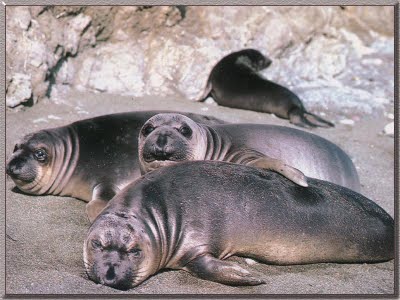
Warriors and Wimps.  From a male's perspective, there are never enough females to go around and so, motivated by lust and sheer greed, each of them comes into serious competition with other philanderers...   (John Sparks, Battle of the Sexes: The Natural History of Sex.  London: BBC Books 1999)

I'll let you guess which non-human animal this excerpt is talking about, though in a sense, the animal referred to is irrelevant, because the story is not really about that species.  It is a high-drama conflict cast in human tones, where male "warriors" battle each other for access to passive females, who seem to be caught in the classic damsel-in-distress syndrome we so often complain about in fantasy fiction.

You guessed right!  Our lusty warriors are elephant seals.
From a biological perspective, we really cannot impose human motivations like "lust" and "sheer greed" on another animals. Nor can we qualify their behavior as "philandering", because terms like these impose moral connotations on patterns that have evolved under natural selection, and therefore have no moral implications whatsoever, not for the animals that engage in the behavior, and certainly not for the humans who study them. 

By this last statement, what I mean is that humans must judge the moral implications of our behavior within the context of our own species and societies; we cannot base our moral codes on the behavior of other animals. Yet often scientific information is communicated in a way that does just that.  Take this example, also discussed in class this week, from a story of human origins that attempts to explain pair-bonding between men and women:

The Naked Ape: Origins.  Male and female hunting apes had to fall in love and remain faithful to one another....In this way, the females were sure of their males' support and were able to devote themselves to their maternal duties.  The males were sure of their females' loyalty, were prepared to leave them for hunting, and avoided fighting over them.  And the offspring were provided with the maximum of care and attention.  (Desmond Morris, The Naked Ape: A Zoologist's Study of the Human Animal. New York: Dell Publishing, 1967.) 

An outdated reference, to be sure.  Since the publication of Morris' version of human cultural history, a lot has changed in the field of paleoanthropology, and in our understanding of the behavior of early humans.  But this still serves as an excellent example of how "scientific" information can be construed to reinforce certain stereotypes -- in this case, a cerca 1950s vision of the ideal family, where Mom stays home with the kids, Dad goes off to a collegial atmosphere at work, both are perfectly faithful to the other, and everyone lives happily ever after. 

Let me take off my scientist cap for a moment and go back to being Karin-the-storyteller, because all this has implications for the stories we tell about the natural world, and the responsiblity we assume in telling them. 

One of my all-time favorite series:
The BBC's Planet Earth

I once saw a fascinating presentation by a BBC filmaker in La Selva Biological Station, where he showed us how the BBC systematically takes unconnected snippets of wildlife footage and manages to weave it all together into an interesting and cohesive drama. 

Truth be told, none of us would watch those BBC wildlife specials if they did not deliver some interesting drama.  And yet, speaking as a professor who has used BBC productions such as Planet Earth in the classroom, a fundamental goal of those series is to communicate the reality of the natural world.  Finding the balance between achieving solid scientific content and creating the drama that will hold the interest of the non-scientist is a constant challenge.  Layer on top of this the need to craft drama in a way that avoids the trap of social stereotypes, and you have a formidable task indeed. 

I've rambled on enough about this.  Now it's your turn. 

Have you run across "scientific" stories that reinforce gender stereotypes?

If so, how would you recast these stories in a way that could avoid those stereotypes? 

Wednesday, August 29, 2012

Biology and Destiny

Myth or history? Pope Joan, an 11th
 century girl who wanted to be a priest,
and made it all the way to the top.
Once upon a time, when I was attending Queen of the Holy Rosary Grade School in Overland Park, Kansas, I wanted to be a priest. 

I was religiously minded as a child, devout in my faith, and most importantly, absolutely convinced I could do a better job with sermons than any of the priests I knew.  

There was, of course, one important problem with my career plan:  I was a girl.  

This was not my first confrontation with the ways in which gender would influence the path of my life, but it was one of the earliest. 


When I decided to direct my professional ambitions toward science instead, I had a very different experience.  I was lucky to be growing up in the 70s and 80s, a time when doors were opening for women in the sciences like never before.  My grade school and middle school science teachers introduced me to the wonders of the solar system, and indulged my dreams of becoming an astronaut.  In high school, my biology teacher facilitated a life-changing experience, allowing me to conduct my own original research for an innovative cancer treatment at the University of Kansas Medical Center. 

Sally Ride, the first woman astronaut
to  reach low earth orbit, was one
of my role models during high school.
By the time I reached college, I had settled comfortably into the assumption that gender was not an issue when it came to pursuing a career in science. So it was something of a surprise when the rules and regulations of gender began to crop up during my undergraduate and graduate years. 

The first indications of gender issues emerged from the stories of my mentors, faculty members who formed part of the first big wave of American women that broke into the academy.  But there were also many incidents I witnessed or experienced, and questions that came with them.

For example, why were most of the graduate students in my department women, while all of the faculty members (with only two exceptions) were men? 


Why did one of our postdocs, when called for a job interview at a prestigious university, fret about the possibility that the selection committee might notice she was pregnant?

Why, among the many pieces of sage advice given to women graduate students, did we inevitably hear the following:  “No babies until after you’ve earned tenure!”  (Which may not sound so bad, until you count up the years and realize you could easily be forty before you are granted tenure.)


Joan E. Strassmann, the evolutionary
biologist who introduced me to the
field of animal behavior at Rice University.
My experiences as a woman growing up in a religion where positions of power are dominated by men, and then building a career in a field very much influenced by the patriarchal mindset, have had an impact on me, and on my understanding of the society in which we live.  What I have learned and seen has even shown up my writing, providing threads for the story of Eolyn, a woman who struggles to forge her own path in a world where the vast majority of people believe one's sex determines one's destiny.


Some might say that Eolyn’s journey has little relevance for the women of today, set as it is in a medieval society built from my imagination.  Yet this semester at Avila, I am teaching Women and Science together with Dr. Carol Coburn, and as we open up the discussion of sex, gender, feminisms (yes, the use of the plural is intentional), patriarchy, history, and power, I am reminded that while times have changed dramatically in many ways, in other ways they have not. 

NAPIRE students Aliah Irvine and
Briana Albini, part of a new
generation of women scientists.

Women and Science is a complex topic.  It requires a careful study of history and society, ample reflection, a critical mind, the ability to see the world through different lenses and to distinguish between fact, myth, and whatever lies in between.  Every two years I get to teach this course, and every time it is a new experience that brings forward unexpected revelations. 

This semester, I’d like to take you with me on this journey of exploring the relationship between women and science.  My occasional blog posts won’t be sufficient to cover everything we talk about in class at Avila, but I will bring some topics to the virtual table for your consideration, including case studies of historical figures such as Hypatia, Rosalind Franklin and Barbara McClintock.  This will be an internal adventure – no jungles to hike through from here to December – but I suspect it will be just as exciting as my 2012 field season, and even more thought-provoking. 

I hope you will join me, and I look forward to having your company, comments and insights along the way. 
 
~*~
 
 
During the month of September we will be celebrating our birthday on Heroines of Fantasy, with giveaways, great sales, and a new regular contributor, poet and author Mark Nelson.  Please stop by to meet Mark and to join the fun!


Thursday, August 23, 2012

Back to School

I'm in a time of transition (once again), coming off a great field season in Costa Rica and beginning the new academic year at Avila.  We have a lot happening -- new staff and faculty, a newly remodeled anatomy & physiology lab, and record enrollment for the fall -- so my calendar has been really packed with meetings and preparation for classes.  All this to say...my post this week won't be all that inspired.  Certainly no pumas or peccaries to write about for the moment.  But there is news to share, so let me take a moment to point you in some interesting directions. 

This week on Heroines of Fantasy, you can listen to an audio recording of an excerpt from my new novel, High Maga.  This is a companion novel to Eolyn; it picks up about 3-4 years after the end of the first novel and can be read as a sequel or a stand-alone.

High Maga includes some of the same characters as Eolyn, in addition to new heroes and villains.  I've had a wonderful adventure working with the characters of this novel -- they are exciting, charismatic, twisted in some cases, noble in others. I'm very much looking forward to being able to share all their stories with you. 

The excerpt I've posted on Heroines of Fantasy features a scene with Eolyn and several new faces:  Borten and Delric, both knights in the service of King Akmael, and Sirena and Melanie, two students of magic who form part of Eolyn's new coven.

Speaking of Heroines of Fantasy, we'll be celebrating one year of Heroines this September with giveaways, special offers and other great surprises.  Stay tuned here, or stop by HoF, to learn how you can be join the fun.

That's the news for this week.  For all of you who are starting the new academic year, enjoy these days of transition and good luck with all your classes.

Tuesday, August 14, 2012

Special Guest Author: DelSheree Gladden

I'm very happy this week to welcome DelSheree Gladden as a guest author.  I met DelSheree through an on-line writing workshop, TheNextBigWriter.com.  From the beginning, I have enjoyed DelSheree's work in fantasy fiction, which blends elements of Southwestern folklore in contemporary settings, and features protagonists with powerful -- and often dark -- gifts.  Today, DelSheree will tell us about the system of magic in The Destroyer Trilogy.  The first book of this trilogy, Inquest, is set to be released by BrionaGlen Publishing in 2012.  Inquest follows sixteen-year-old Libby Sparks as she tries to escape her destiny to destroy the world. But Libby soon realizes dodging fate might not be worth the price. 

Please keep reading at the end of DelSheree's post, as she has also provided a special sneak preview of the novel. 


Magic in the Destroyer Trilogy


Thank you, Karin, for having me on your blog today. I am excited to have the opportunity to talk about the system of magic used in my new series, “The Destroyer Trilogy.” The first book in this series is “Inquest,” which will be released this month by Briona Glen Publishing. “Inquest” follows sixteen-year-old Libby Sparks as she tries to avoid her destiny to destroy the world.

The magic system used in “Inquest” is based on talents. There are seven possible talents: Speed, Strength, Naturalism, Spiritualism, Perception, Concealment, and Vision. The more talents the better…except in Libby’s case. Seven talents mark Libby as the prophesied Destroyer, a legend destined to destroy the world. Talents are meant for good, but Libby soon realizes they can be twisted to evil.

Speed and Strength: These are two of the most familiar of the talents. As their names indicate, Speed makes a person able to move incredibly fast, but without Strength, pushing your body to such extremes would damage your muscles and joints. These two talents are always paired, and they are the basic requirement for becoming a Guardian—the military force whose sole purpose is the kill the Destroyer.

Naturalism: This talent allows the bearer to connect with the natural world to nurture plant and animal life, manipulate natural elements like paints, rock, or fabrics produces amazing pieces of art, and even heal the human body. Twisted for darker purposes, Naturalism can also end life.

Spiritualism: This talent has a dual purpose. It can send the talent bearer’s spirit into the spirit world to commune with the spirits who reside there, or help soothe, calm, or guide a person. But, it can also be used to manipulate someone into doing what you want.

Perception: An extremely useful, yet often annoying talent, allows the bearer to sense another’s emotions. This allows the bearer to interpret emotions and discover when a person is telling the truth or lying. Perception is also the base talent needed to perform an Inquest—an ability that it highly prized.

Concealment: A talent with many uses, Concealment can seek out truth, as well as physical items or people. It can also conceal the bearer’s presence from others. Unfortunately it can also be used to hide and deceive.

Vision: This is by far the most unreliable of all the talents. However, knowing the future before it happens also makes it the most valuable of all the talents. This talent is especially sought after by the Guardians, making them extremely powerful.

These are the basics of what each talent can do, but hardly the limits of what a truly powerful person can achieve. As Libby faces both her destiny and the Guardians, she is forced to push the limits of each talent in her arsenal. Libby will shock not only herself, but the world with what she can do.
Thank you again to Karin for allowing me to stop by and share a little bit about my book.  Happy reading, everyone!


Excerpt from Chapter Five of Inquest


“I do hope you are patient with me, Libby,” Mr. Walters says, interrupting my thoughts. “It’s not an easy task to consolidate a lifetime of research into a curriculum overnight. I do hope that by the end of the year you’ll have a better understanding of what you will be expected to do as the only member of the Destroyer class.”

“Uh, really?”

You would think the majority of the world would be much happier if I had no idea what I was supposed to do as the Destroyer. I’m not even sure I want to know what I’m supposed to do. Every time I’ve tried to find out it never led anywhere good, so now I’d like to avoid finding out in the hopes that if I don’t know I’ll never actually do anything bad.

“Of course, dear. You have to know your purpose in life if you expect to ever accomplish it, don’t you?”

There is something wrong with this man. “But I don’t want to fulfill my purpose. I don’t want to hurt or destroy anything. You don’t want me to do that either. Nobody does!”

“Well, of course no one wants to see you harm anyone, but that’s hardly the point,” Mr. Walters says.

“How is that not the point?”

“Because the point of this class is to teach you to be the best Destroyer you can possibly be. What you do with that knowledge is completely up to you, but I refuse to have a student leave one of my classes not fully trained to do their duty.”

He’s serious. As if my killing people a few years from now has no bearing on his teaching me to do it, he opens his notebook and instructs me to do the same. What choice do I have but to follow him?

“Now,” he says, “I have been researching the Destroyer class most of my life. It has always fascinated me that there is only one member, one single person meant to destroy our entire society. When we have millions of Guardians to fight against the Destroyer, Visionaries who might see her coming, Concealers to find her, etc., I have always been curious about how this one person is actually meant to succeed.”

I cough and interrupt his rambling. “If the Destroyer, me, has all the talents of the ones meant to stop me, then all I have to do is use the talents I have against them, right? That’s hardly a mystery.”

“Precisely,” he says, “but the problem is that while a Guardian only needs to focus on honing Speed and Strength, you must master all seven talents if you have any hope of surviving past your eighteenth birthday. Mastering one or two talents takes years, decades even, but you only have two years. That, my dear, is the real question that has plagued me for so long. How can one person reach perfection before the whole world turns on her?”

“Oh. Yeah, I guess that would be something of a problem, if I was planning on actually surviving longer than two years,” I say.

Mr. Walters simply blinks at me. “You mean you don’t plan on surviving?”

“Uh, not really.”

“Why not?”

“Because it’s impossible, for one, and surviving would mean hurting people, ruining lives. I don’t want to be a part of that. I’d rather let one of those psychotic Guardians slice me into little pieces than watch myself do the same thing to someone else.”

No matter what anyone says, I will not hurt anyone. Not again.

Walking over to my desk at a slow, thoughtful pace, Mr. Walters surprises me by touching his index finger to the spot of dried blood on my neck. “If you don’t want your gifts then why didn’t you let Lance or the Guardian kill you last night? Why don’t you kill yourself right now?”

He pushes back his blazer sleeve and snatches the Guardian blade out of its sheath so quickly I barely see more than a flash of light on steel before it is pressing against my throat. A Guardian. My heart is pounding against my chest, my mind screaming at me to run. I am alone in a room with a Guardian who is apparently obsessed with the Destroyer. With me. And he has a knife balanced exactly against my carotid artery. Black spots fleck my vision and I realize I’m hyperventilating. It requires all my quickly vanishing willpower to tap my Naturalism and slow my breathing enough to see clearly again.

“If you ask me to kill you, I will do that for you, Libby, though I would not take any pleasure in it,” Mr. Walters says. “Or if you prefer to end your life by your own hand, I will not stop you. Either way, if death is what you truly want, I will allow you to have it. Right here. Right now. This is the only time I will make this offer, Libby. It is your choice.”

The pressure of the blade on my skin increases slightly, and I cry out. “No! No don’t!”

Instantly the knife is withdrawn, back in its sheath like it never left. “Why?” he asks.

“Because I don’t want to die,” I say. Tears bleed down my cheeks and I wipe them away furiously, angrily.

“You will die eventually. There is no doubting that.”

“But I don’t want to die yet, not today. Not for as long as I can manage it.” Maybe it’s wrong to want to live. With everything I’ve done, and am, I probably deserve to die. But I don’t want to. Not yet.

Placing his hands on my desk, Mr. Walters leans forward.  His wizened features grow eerily strong and firm as he peers down at me.  "If you don't want to die, then you have to embrace who and what you are Libby.  Becoming the Destroyer is the only thing that is going to keep you alive."

~*~


DelSheree Gladden lives in New Mexico with her husband and two children. The Southwest has a big influence on her writing because of its culture, beauty and mythology. Local folk lore is strongly rooted in her writing, particularly ideas of prophecy, destiny, and talents born from natural abilities. When she is not writing, DelSheree is usually teaching yoga, coaching gymnastics, reading, painting, sewing or studying about teeth as a Dental Hygiene student.  In addition to The Destroyer Trilogy, her works include Escaping Fate and the Twin Souls Saga.  Visit DelSheree at her blog The Edible Bookshelf.   

Friday, August 10, 2012

Saying Farewell

"Eolyn's heart wavered, overtaken by a sudden nostalgia, the intense joy of companionship intermingled with the haunting sense that everything she most loved in life was constantly slipping away."  -- HIGH MAGA, Chapter 9

It's been almost two weeks since the Native American and Pacific Islander (NAPIRE) Program ended.  I've been involved with NAPIRE in one way or another for many years now, and have always enjoyed it.  Yet something about NAPIRE 2012 was especially extraordinary; this particular mix of people -- both mentors and students -- had a kind of magic that is difficult to find, and was hard to leave behind.

I'm not always very good at saying good-bye, though I've somehow built a life that requires letting go on a regular basis.  My friends and family are scattered across the globe -- in the United States, Germany, Costa Rica, and Hong Kong; in Washington D.C., Colorado, Connecticut, and California, to name just a few.  On the one hand, it's a wonderful situation because I feel part of a diverse community of very special people whose friendship transcends distance, culture, and time.  There's no better period in history than now to live an experience like this one, as technology has made it easier than ever to stay in touch across the miles.  But the next best thing to being there is still just that -- the next best thing. 

Even though it is painful to part with good friends, saying good-bye is often necessary in order to start anew.  With the end of NAPIRE 2012, each individual who helped make this summer such a successful season of research and cultural exchange can embark on a new future.  We have lost each other's company -- in the immediate, physical sense of the word -- but our lives have been made richer, our community larger, and our spirits stronger, because of all the adventures we have shared.

From a larger perspective, the joy of starting anew is almost invariably coupled with the pain of letting go.  A friend of mine once said that every gain we make in life is coupled with loss, or sacrifice.  I am reluctant to accept this wisdom, though I find myself living her words over and again.  More fundamentally, I find myself writing her words into my stories, first with the novel Eolyn, and now  with High Maga, in which my characters live a tale of unrelenting loss, though each moment of pain eventually forms the foundation for a future of renewed hope. 

This is my final installment for Field Season 2012, and I want to thank all of you who accompanied me on my trek through the forests of North and Central America.  It's been a wonderful summer; I hope you have enjoyed it as much as I have.

This week on Heroines of Fantasy, Kim Vandervort writes about Modern Heroes and how the Olympic atheletes inspire her work.   Next week, also on Heroines of Fantasy, we will welcome guest author Jim C. Hines. 

Also, please come back here on August 14th to read a post by special guest author DelSheree Gladden, who will tell us about her soon-to-be-released fantasy novel, Inquest: The Destroyer.