"Vigorously told deceptions and battle scenes." ~Publishers Weekly review of Eolyn

"The characters are at their best when the events engulfing them are at their worst." ~Publishers Weekly review of High Maga
Showing posts with label gender. Show all posts

Friday, September 7, 2012

Warriors and Wimps

Color-enhanced electron micrograph of a human ovum and sperm.
Stories of fertilization are loaded with gender stereotypes, even
in modern-day textbooks.  See the artist's rendition below.

anthropomorphic 1. ascribing human form or attributes to a being or thing not human.  2. resembling or made to resemble human form.

I've touched upon the topic of anthropomorphism before, in my post Animating the Forest, part of my series of reflections for the 2011 Andrews Forest Writers Residency.  There I talked about the tension between me-the-writer and me-the-scientist when interacting with the forest, and how my desire to avoid anthropomorphism influenced the way I write about the natural world, and the way animals were portrayed in the novel Eolyn. 
A common artist's rendition of fertilization, where
the voyage of the sperm appears as a kind of space
odyssey:  To explore strange worlds, to seek out new
life, to boldly go where no man has gone before...

As a biology professor, I run into anthropomorphisms on a a daily basis, sometimes in unexpected places.  For example, today in introductory biology we introduced the term hydrophilic, which one of the students was quick to define as "water-loving". 

Hydrophilic compounds have an affinity for water, and so "water-loving" is a catchy phrase that can help students remember what hydrophilic means and how it applies to biology and chemistry.  But -- let's face it -- molecules are not capable of "loving" anything. An innocent anthropomorphism, but an anthropomorphism nonetheless.

Women and Science this week also tackled the subject of anthropomorphism. We often use human characteristics to tell stories about the natural world, and as a result these stories, though meant to communicate scientific information, are often couched in terms that reflect and reinforce gender stereotypes.  Take this example which we looked at just yesterday:

Warriors and Wimps.  From a male's perspective, there are never enough females to go around and so, motivated by lust and sheer greed, each of them comes into serious competition with other philanderers...   (John Sparks, Battle of the Sexes: The Natural History of Sex.  London: BBC Books 1999)

I'll let you guess which non-human animal this excerpt is talking about, though in a sense, the animal referred to is irrelevant, because the story is not really about that species.  It is a high-drama conflict cast in human tones, where male "warriors" battle each other for access to passive females, who seem to be caught in the classic damsel-in-distress syndrome we so often complain about in fantasy fiction.
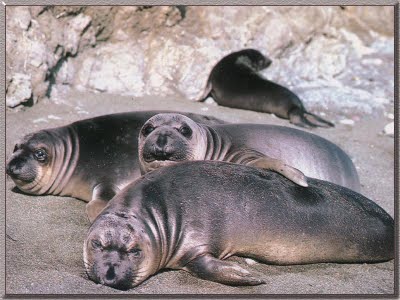
You guessed right!  Our lusty warriors are elephant seals.
From a biological perspective, we really cannot impose human motivations like "lust" and "sheer greed" on another animals. Nor can we qualify their behavior as "philandering", because terms like these impose moral connotations on patterns that have evolved under natural selection, and therefore have no moral implications whatsoever, not for the animals that engage in the behavior, and certainly not for the humans who study them. 

By this last statement, what I mean is that humans must judge the moral implications of our behavior within the context of our own species and societies; we cannot base our moral codes on the behavior of other animals. Yet often scientific information is communicated in a way that does just that.  Take this example, also discussed in class this week, from a story of human origins that attempts to explain pair-bonding between men and women:

The Naked Ape: Origins.  Male and female hunting apes had to fall in love and remain faithful to one another....In this way, the females were sure of their males' support and were able to devote themselves to their maternal duties.  The males were sure of their females' loyalty, were prepared to leave them for hunting, and avoided fighting over them.  And the offspring were provided with the maximum of care and attention.  (Desmond Morris, The Naked Ape: A Zoologist's Study of the Human Animal. New York: Dell Publishing, 1967.) 

An outdated reference, to be sure.  Since the publication of Morris' version of human cultural history, a lot has changed in the field of paleoanthropology, and in our understanding of the behavior of early humans.  But this still serves as an excellent example of how "scientific" information can be construed to reinforce certain stereotypes -- in this case, a cerca 1950s vision of the ideal family, where Mom stays home with the kids, Dad goes off to a collegial atmosphere at work, both are perfectly faithful to the other, and everyone lives happily ever after. 

Let me take off my scientist cap for a moment and go back to being Karin-the-storyteller, because all this has implications for the stories we tell about the natural world, and the responsiblity we assume in telling them. 

One of my all-time favorite series:
The BBC's Planet Earth

I once saw a fascinating presentation by a BBC filmaker in La Selva Biological Station, where he showed us how the BBC systematically takes unconnected snippets of wildlife footage and manages to weave it all together into an interesting and cohesive drama. 

Truth be told, none of us would watch those BBC wildlife specials if they did not deliver some interesting drama.  And yet, speaking as a professor who has used BBC productions such as Planet Earth in the classroom, a fundamental goal of those series is to communicate the reality of the natural world.  Finding the balance between achieving solid scientific content and creating the drama that will hold the interest of the non-scientist is a constant challenge.  Layer on top of this the need to craft drama in a way that avoids the trap of social stereotypes, and you have a formidable task indeed. 

I've rambled on enough about this.  Now it's your turn. 

Have you run across "scientific" stories that reinforce gender stereotypes?

If so, how would you recast these stories in a way that could avoid those stereotypes? 

Wednesday, August 29, 2012

Biology and Destiny

Myth or history? Pope Joan, an 11th
 century girl who wanted to be a priest,
and made it all the way to the top.
Once upon a time, when I was attending Queen of the Holy Rosary Grade School in Overland Park, Kansas, I wanted to be a priest. 

I was religiously minded as a child, devout in my faith, and most importantly, absolutely convinced I could do a better job with sermons than any of the priests I knew.  

There was, of course, one important problem with my career plan:  I was a girl.  

This was not my first confrontation with the ways in which gender would influence the path of my life, but it was one of the earliest. 


When I decided to direct my professional ambitions toward science instead, I had a very different experience.  I was lucky to be growing up in the 70s and 80s, a time when doors were opening for women in the sciences like never before.  My grade school and middle school science teachers introduced me to the wonders of the solar system, and indulged my dreams of becoming an astronaut.  In high school, my biology teacher facilitated a life-changing experience, allowing me to conduct my own original research for an innovative cancer treatment at the University of Kansas Medical Center. 

Sally Ride, the first woman astronaut
to  reach low earth orbit, was one
of my role models during high school.
By the time I reached college, I had settled comfortably into the assumption that gender was not an issue when it came to pursuing a career in science. So it was something of a surprise when the rules and regulations of gender began to crop up during my undergraduate and graduate years. 

The first indications of gender issues emerged from the stories of my mentors, faculty members who formed part of the first big wave of American women that broke into the academy.  But there were also many incidents I witnessed or experienced, and questions that came with them.

For example, why were most of the graduate students in my department women, while all of the faculty members (with only two exceptions) were men? 


Why did one of our postdocs, when called for a job interview at a prestigious university, fret about the possibility that the selection committee might notice she was pregnant?

Why, among the many pieces of sage advice given to women graduate students, did we inevitably hear the following:  “No babies until after you’ve earned tenure!”  (Which may not sound so bad, until you count up the years and realize you could easily be forty before you are granted tenure.)


Joan E. Strassmann, the evolutionary
biologist who introduced me to the
field of animal behavior at Rice University.
My experiences as a woman growing up in a religion where positions of power are dominated by men, and then building a career in a field very much influenced by the patriarchal mindset, have had an impact on me, and on my understanding of the society in which we live.  What I have learned and seen has even shown up my writing, providing threads for the story of Eolyn, a woman who struggles to forge her own path in a world where the vast majority of people believe one's sex determines one's destiny.


Some might say that Eolyn’s journey has little relevance for the women of today, set as it is in a medieval society built from my imagination.  Yet this semester at Avila, I am teaching Women and Science together with Dr. Carol Coburn, and as we open up the discussion of sex, gender, feminisms (yes, the use of the plural is intentional), patriarchy, history, and power, I am reminded that while times have changed dramatically in many ways, in other ways they have not. 

NAPIRE students Aliah Irvine and
Briana Albini, part of a new
generation of women scientists.

Women and Science is a complex topic.  It requires a careful study of history and society, ample reflection, a critical mind, the ability to see the world through different lenses and to distinguish between fact, myth, and whatever lies in between.  Every two years I get to teach this course, and every time it is a new experience that brings forward unexpected revelations. 

This semester, I’d like to take you with me on this journey of exploring the relationship between women and science.  My occasional blog posts won’t be sufficient to cover everything we talk about in class at Avila, but I will bring some topics to the virtual table for your consideration, including case studies of historical figures such as Hypatia, Rosalind Franklin and Barbara McClintock.  This will be an internal adventure – no jungles to hike through from here to December – but I suspect it will be just as exciting as my 2012 field season, and even more thought-provoking. 

I hope you will join me, and I look forward to having your company, comments and insights along the way. 
 
~*~
 
 
During the month of September we will be celebrating our birthday on Heroines of Fantasy, with giveaways, great sales, and a new regular contributor, poet and author Mark Nelson.  Please stop by to meet Mark and to join the fun!