"Vigorously told deceptions and battle scenes." ~Publishers Weekly review of Eolyn

"The characters are at their best when the events engulfing them are at their worst." ~Publishers Weekly review of High Maga
Showing posts with label anthropomorphism. Show all posts

Friday, September 7, 2012

Warriors and Wimps

Color-enhanced electron micrograph of a human ovum and sperm.
Stories of fertilization are loaded with gender stereotypes, even
in modern-day textbooks.  See the artist's rendition below.

anthropomorphic 1. ascribing human form or attributes to a being or thing not human.  2. resembling or made to resemble human form.

I've touched upon the topic of anthropomorphism before, in my post Animating the Forest, part of my series of reflections for the 2011 Andrews Forest Writers Residency.  There I talked about the tension between me-the-writer and me-the-scientist when interacting with the forest, and how my desire to avoid anthropomorphism influenced the way I write about the natural world, and the way animals were portrayed in the novel Eolyn. 
A common artist's rendition of fertilization, where
the voyage of the sperm appears as a kind of space
odyssey:  To explore strange worlds, to seek out new
life, to boldly go where no man has gone before...

As a biology professor, I run into anthropomorphisms on a a daily basis, sometimes in unexpected places.  For example, today in introductory biology we introduced the term hydrophilic, which one of the students was quick to define as "water-loving". 

Hydrophilic compounds have an affinity for water, and so "water-loving" is a catchy phrase that can help students remember what hydrophilic means and how it applies to biology and chemistry.  But -- let's face it -- molecules are not capable of "loving" anything. An innocent anthropomorphism, but an anthropomorphism nonetheless.

Women and Science this week also tackled the subject of anthropomorphism. We often use human characteristics to tell stories about the natural world, and as a result these stories, though meant to communicate scientific information, are often couched in terms that reflect and reinforce gender stereotypes.  Take this example which we looked at just yesterday:

Warriors and Wimps.  From a male's perspective, there are never enough females to go around and so, motivated by lust and sheer greed, each of them comes into serious competition with other philanderers...   (John Sparks, Battle of the Sexes: The Natural History of Sex.  London: BBC Books 1999)

I'll let you guess which non-human animal this excerpt is talking about, though in a sense, the animal referred to is irrelevant, because the story is not really about that species.  It is a high-drama conflict cast in human tones, where male "warriors" battle each other for access to passive females, who seem to be caught in the classic damsel-in-distress syndrome we so often complain about in fantasy fiction.
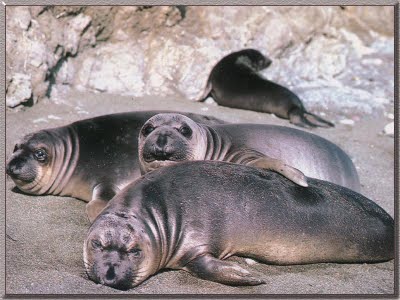
You guessed right!  Our lusty warriors are elephant seals.
From a biological perspective, we really cannot impose human motivations like "lust" and "sheer greed" on another animals. Nor can we qualify their behavior as "philandering", because terms like these impose moral connotations on patterns that have evolved under natural selection, and therefore have no moral implications whatsoever, not for the animals that engage in the behavior, and certainly not for the humans who study them. 

By this last statement, what I mean is that humans must judge the moral implications of our behavior within the context of our own species and societies; we cannot base our moral codes on the behavior of other animals. Yet often scientific information is communicated in a way that does just that.  Take this example, also discussed in class this week, from a story of human origins that attempts to explain pair-bonding between men and women:

The Naked Ape: Origins.  Male and female hunting apes had to fall in love and remain faithful to one another....In this way, the females were sure of their males' support and were able to devote themselves to their maternal duties.  The males were sure of their females' loyalty, were prepared to leave them for hunting, and avoided fighting over them.  And the offspring were provided with the maximum of care and attention.  (Desmond Morris, The Naked Ape: A Zoologist's Study of the Human Animal. New York: Dell Publishing, 1967.) 

An outdated reference, to be sure.  Since the publication of Morris' version of human cultural history, a lot has changed in the field of paleoanthropology, and in our understanding of the behavior of early humans.  But this still serves as an excellent example of how "scientific" information can be construed to reinforce certain stereotypes -- in this case, a cerca 1950s vision of the ideal family, where Mom stays home with the kids, Dad goes off to a collegial atmosphere at work, both are perfectly faithful to the other, and everyone lives happily ever after. 

Let me take off my scientist cap for a moment and go back to being Karin-the-storyteller, because all this has implications for the stories we tell about the natural world, and the responsiblity we assume in telling them. 

One of my all-time favorite series:
The BBC's Planet Earth

I once saw a fascinating presentation by a BBC filmaker in La Selva Biological Station, where he showed us how the BBC systematically takes unconnected snippets of wildlife footage and manages to weave it all together into an interesting and cohesive drama. 

Truth be told, none of us would watch those BBC wildlife specials if they did not deliver some interesting drama.  And yet, speaking as a professor who has used BBC productions such as Planet Earth in the classroom, a fundamental goal of those series is to communicate the reality of the natural world.  Finding the balance between achieving solid scientific content and creating the drama that will hold the interest of the non-scientist is a constant challenge.  Layer on top of this the need to craft drama in a way that avoids the trap of social stereotypes, and you have a formidable task indeed. 

I've rambled on enough about this.  Now it's your turn. 

Have you run across "scientific" stories that reinforce gender stereotypes?

If so, how would you recast these stories in a way that could avoid those stereotypes? 

Sunday, June 19, 2011

Animating the Forest

An "Ent" as depicted in the Lord of the Rings film series.
There are a couple of lingering topics from my week at Andrews Forest, and I want to return to one of them today.

During a follow up conversation with Frederick J. Swanson, one of the coordinators of the Long Term Ecological Reflections project at Andrews, he expressed interest in knowing more about ‘what I had to let go of’ when trying to consider the forest from a writer’s perspective, having been trained for so long to approach the forest as a scientist.

I’d say the most difficult impulse for me to follow – to put my faith in, so to speak -- was the desire to anthropomorphize the creatures around me, to animate them with human qualities.

It is very common for story tellers (and humans in general) to anthropomorphize animals and other non-human creatures. Walt Disney’s The Lion King, for example, imposes a human social structure and human behavior on lions and their cohorts in the grasslands of Africa, so that what appears to be a story about lions is, in fact, a story about humans dressed up as lions.

Disney, of course, does this with a lot of films; but I chose The Lion King is an example because the first animal social structure I learned about when I began my study of behavioral biology was in fact the lions.

Lions live in matriarchal prides, where territory is shared among sisters and passed from mothers to daughters. Males leave the pride when they reach reproductive age and live alone or in small groups (usually pairs of brothers) until they are able to challenge and replace the reproductive male of another pride. Upon ‘taking over’ a pride, a new male kills all the cubs in that pride, causing the females to enter their reproductive cycle earlier than they would have otherwise. The new male then has about two or three years to sire as many cubs as he can (and see them safely to maturity) before he, in turn, is booted out by a younger, healthier rival, who will then proceed to kill all the cubs that his predecessor sired.

Not the stuff of Disney movies, I suppose. But it was through the lions that I first realized most animals interact with each other in ways that are difficult to understand if measured by a human world view. We must use other tools – in this case, evolutionary theory – to make sense of their behavior.

The danger, for a scientist, of anthropomorphizing is that the moment we dress up another species with human qualities, we handicap our capacity to understand them on their own terms. So as a biologist, I have for years coached myself – and all my students – away from the habit of anthropomorphizing. (I might add that this is also the approach that the Magas and Mages of Eolyn’s world take; they do not impose human qualities on the plants and animals with which they interact; nor do I as the author.)

While I was in Andrews, whenever I found myself wanting to give voice and personality to the trees and other creatures, my first instinct was to back away. But this instinct ran contrary to the number one rule of any creative writer, which is not to censor yourself. In order to honor me-the-writer, I occasionally had to let go of me-the-scientist.

Anthropomorphizing may be treacherous ground for an ecologist, but it can be a powerful tool for the story teller. If used well in the attempt to relate something as complex as the experience of walking through a forest, the occasional anthropomorphic creature allows the reader a familiar thread that can help carry him or her through otherwise unknown territory. How many children, for example, came to love lions because of The Lion King? And would they have been so quick in their affection for this imposing predator, if the first thing they had learned about it was the customary massacre of all those sweet and playful cubs every time a new male takes over a pride?

While I appreciate the benefits of anthropomorphizing, something inside me cringes every time I see a movie – or read a story – where animals think, talk and act like humans. In my own work as a writer I try to avoid this, seeking a balance between making the creatures of Eolyn’s world accessible while respecting their fundamental non-human qualities.

An "Ent" of Andrews Forest
One of my favorite examples of a skillful anthropomorphism in fantasy is J.R.R. Tolkien’s Ents, the tree shepherds, which are essentially anthropomorphized trees. Tolkien allows Ents to wander through the forest, speak with hobbits, and even go to war. He hints at a loose social structure and the one-time existence of Ent-Wives.  Ent-Wives are very cool; they are credited with having taught the people of Middle Earth much about agriculture.  Nonetheless, a 'wife' is a kind of pointless concept for real trees, most of which have both male and female reproductive parts, and because the offspring take care of themselves, there’s no need for the pair bonding we tend to see in animals.

Despite all these human-like qualities, Ents never lose their essential tree-ness. I think that’s part of what gives Ents their immortality in our imagination, and why every time I enter a forest, I half expect to see one – whether I’m thinking like a scientist or not.


This is part of a series of reflections based on my experiences as a writer-in-residence at Andrews Experimental Forest in Oregon.  If you'd like to read more about my week-long stay at Andrews, check out the links under "Spring 2011 Residency at Andrew Forest" on the right-hand bar.