"Vigorously told deceptions and battle scenes." ~Publishers Weekly review of Eolyn

"The characters are at their best when the events engulfing them are at their worst." ~Publishers Weekly review of High Maga
Showing posts with label Las Cruces. Show all posts

Tuesday, July 8, 2014

Checking in From Las Cruces

On the trail in Amistad Biosphere Reserve.
 This summer has been so extraordinarily active, I've had very little time to just "hang out" on the internet.

All in all, NAPIRE has been an amazing new journey through Costa Rica. From the lowland Caribbean forests to the high reaches of the Talamanca mountain ranges, we have seen a lot in a very short period of time.  The students are running a great blog about the program, and I invite you to visit their website. There are a lot of photos and updates on the various sites we have visited, including La Selva Biological Station, the Bribri indigenous community, and of course, Las Cruces.

My role this summer is very different from previous NAPIRE programs. As a NAPIRE mentor, I was basically out in the forest every single day. Now, I am more tied to the station as we seek to facilitate some twenty research projects over the next few weeks.

Still, I get my chances. Yesterday I took a half-day hike up the Ridge Trail and along the Wilson loop. I was able to visit the plants that my students have worked with in the past.  They are looking well; probably enjoying the rest from nosy scientists like me.

Wildlife was a little scarce compared to previous summers; no monkeys or snakes or elusive cat-like animals. I did come across a giant toad. Well situated in the middle of the path, it sat like a stone while I took pictures. Not one of my photos really did it justice, but at least it was patient with all the flashes.

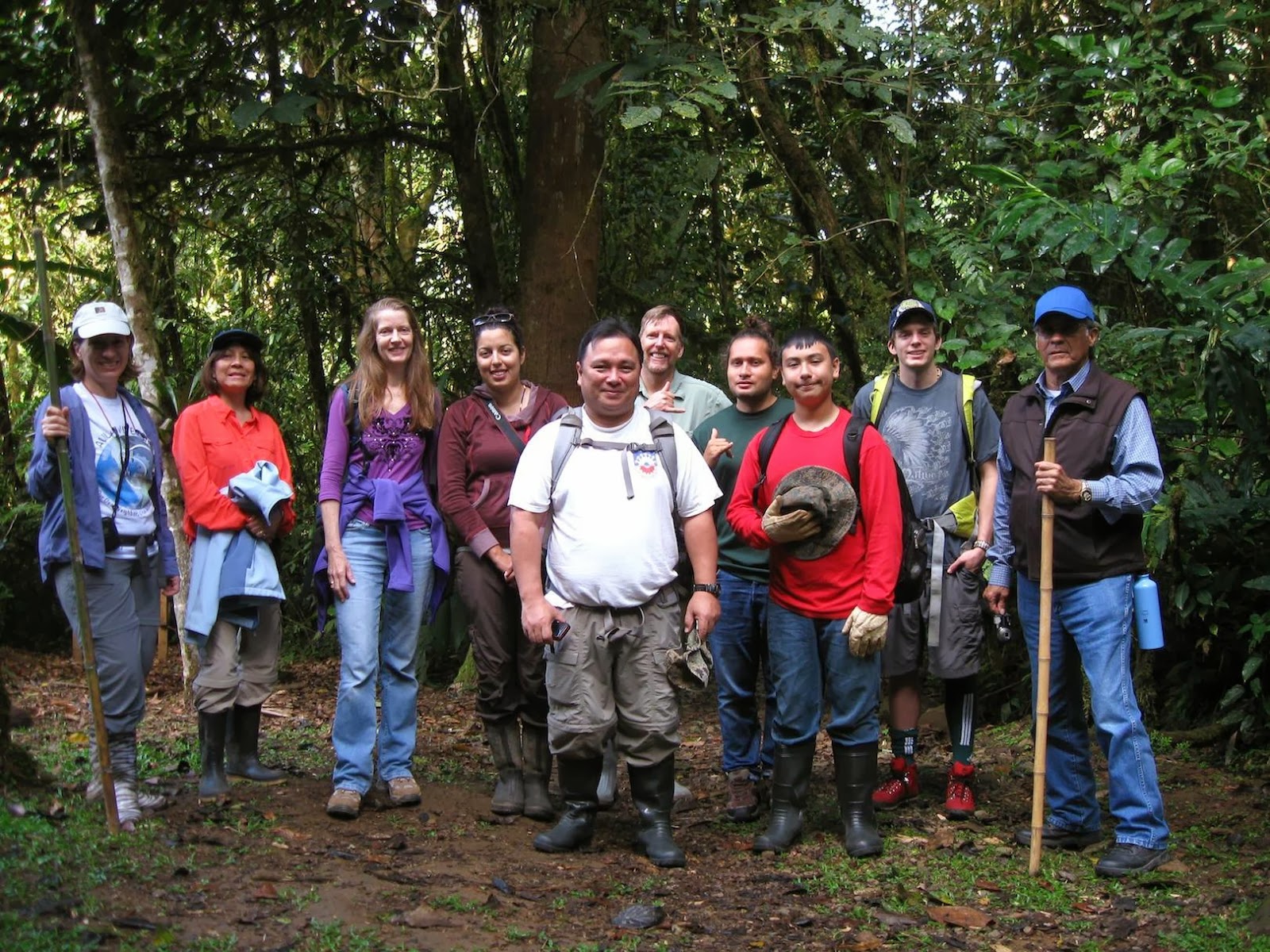
Our happy-go-lucky group at the peak of Cerro Chai.
We spent last weekend at Las Alturas Biological Station, on the border of La Amistad Biosphere Reserve in Costa Rica. Amistad stretches across the Talamanca mountain range into Panama and provides a home for many montane ecosystems, including the highland oak forests that inspired Eolyn. There we saw countless animals, including two species of monkeys, various birds, and a wonderful variety of colorful butterflies. I was secretly hoping to come across the giant peccaries I saw two years ago, but no such luck on this trip.

Las Alturas and Las Cruces are not that distant from each other, and are only 300m apart in elevation. So it's always striking to see the difference in animal life between the two sites. Probably the main reason for fewer mammal species at Las Cruces is that the forest here is much smaller and more isolated.

The station director, Dr. Rakan Zahawi, has done a great job of adding pieces to the reserve over the past decade, bringing the total area to about 250 hectares. Still, that pales compared to the 570,000 has set aside for La Amistad International Park.

A glimpse of the vast expanse of La Amistad.
There is a long term project to connect Las Cruces to the nearby Ngobe Indigenous Territory, and from there create a corridor that runs all the way from Amistad to the Pacific lowlands. A corridor that size would transform the natural landscape and ensure the future of wildlife in the region. If you're looking for a great conservation cause to contribute to, visit OTS' website and make a donation to Las Cruces Biological Station. You can specify what you want your donation to go to; in this case, indicate the funds are for land purchases for the biological corridor.

Speaking of great causes, Hadley Rille Books indiegogo campaign is in full swing, and looking for more donations. Hadley Rille Books provides a different sort of habitat for another rare and beautiful species, the True Heroine. There are many great perks for all levels of donation, but the best perk of all is knowing your money is going toward a quality small press that supports historically underrepresented voices in the genre. Please visit their site to learn more about the campaign and make your contribution today.

Last but not least:  Eolyn's Amazing Audio Book Tour is about to begin!  I've coordinated this tour through Daniel Marvelo's Magic Appreciation Tour network, and added a couple friends of my own in the mix. In addition to many great posts about magic, publishing, and the adventure of producing an audio book, the tour will include a giveaway of 5 free copies of the audio edition of Eolyn. I will post the full tour schedule by Monday, July 14th, so look for that in the coming days.

Those are the updates for now. I'll leave you with this fun video by Juan Luis Guerra; it's a song that has for some reason become my personal theme for Summer 2014. (Must be the road trip through the Latin American country side!) Enjoy.


Pura Vida!

Monday, June 2, 2014

NAPIRE 2014

Me and one of my old friends at Las Cruces.
The semester at Avila has ended, and all of the sudden I find myself in Costa Rica preparing for my next NAPIRE summer.

Those of you who follow my blog may remember that every other year I return to Las Cruces Biological Station in southern Costa Rica to participate in the Native American and Pacific Islander Research Experience (NAPIRE) Program

Funded by NSF and LSAMP, this 8-week adventure brings together Native American and Pacific Islander undergraduate students, who conduct independent research under the guidance of experienced field ecologists. Students identify questions and hypotheses, design and implement their own experiment, and analyze, interpret, and present the results. All of this in the context of the magnificent mid-elevation tropical forest that characterizes the mountains of southern Costa Rica. 

I helped set up NAPIRE back in 2006, when I was still working full time for Duke University and the Organization for Tropical Studies. After accepting my current position at Avila University, I’ve returned every other year to participate in NAPIRE as a research mentor. This year I’ve taken on a new and somewhat daunting challenge: I will be co-coordinating the program with Barbara Dugelby. Our team includes two teaching assistants, Lelemia Irvine, a kukupu o ka aina of Hawaii, and Nicole Kenote, a member of the Menominee Indian Tribe of Wisconsin. 
NAPIRE Best Practices workshop in January 2014.
Diverse cultures, diverse minds, diverse forests.
Photo courtesy of Lelemia Irvine.

When the 2014 NAPIRE community is complete, it will consist of 20 students from various Native American Tribes and Pacific Islander Peoples, as well as 10 mentors from around the world. In addition, we will be welcoming mentors from our students’ home institutions as well as a tribal elder, Dr. Don Pepion, and a cultural practitioner, Ku'umeaaloha Gomes.


I have long had an instinctive love for NAPIRE. From the first time I heard about the program, I understood that this is one of those rare initiatives that could truly transform the world. Not from one day to the next, of course, but by planting seeds of change capable of germinating and flourishing long after the 8-week experience has concluded. This because NAPIRE not only teaches students science, it seeks to bridge the gap between scientific and indigenous knowledge systems — a gap that all too often seems insurmountable, abyssal in its depths, ready to swallow anyone who attempts to cross it.


As part of my personal preparation for this summer’s program, I have begun reading Grandmothers Counsel the World, a book by Carol Schaefer that consolidates the experience and wisdom of 13 women elders from different indigenous tribes.


In the foreword, Winona LaDuke makes a compelling argument that the current paradigm, driven in part by a Western approach to science, cannot show us the way out of the planetary crisis, because it is precisely this paradigm that created the problem the first place.


This is a difficult argument for an ecologist to read, even more difficult when the words sting with the weight of truth.


And so the question sticks in my mind:


Can science solve the problems science has created?


I have a feeling I will be mulling over this one for some time, perhaps the entire summer and beyond.


On the one hand, scientific advancement has allowed us to exploit the planet in a way never before seen in history.


At the same time, science has illuminated the extent of the damage we have done, and continue to do. Data gathered by scientists has often urged us into decisive action, as for example with the Clean Air Act of 1970 and the Montreal Protocol (1987).


Science is extraordinarily powerful when it comes to deciphering the inner workings of the natural world, yet science offers little in terms of guidance regarding what to do with that information.


Where, then, can we turn for such sorely needed guidance?


Schaefer and LaDuke point to the Grandmothers and their collective wisdom, a rich reservoir of knowledge that spans hundreds, even thousands, of years. Indigenous knowledge systems, they argue, are not simply a place to start. They should occupy a central role in our collective effort to ensure a better, more sustainable future for all of humanity.


All of this brings me back to NAPIRE, a relatively modest effort to create a playing field on which scientific and indigenous knowledge systems interact on equal terms. Every summer I’ve joined NAPIRE has been a new adventure, each iteration distinct in many important ways from the last. Yet no matter the particular experiences of a given summer, I always come away with a deeper appreciation of NAPIRE students and the many cultures they represent. I know the much of the future rests in their hands, and that thought gives me a lot of hope.


This is one of many reasons why I am so excited that the door to NAPIRE 2014 is about to open, allowing me to participate in the many challenges and unique gifts this opportunity has to offer. I invite you to join me as a virtual companion when I step through that door, as the NAPIRE experience will be the focus of many posts from now through early August.

This is one adventure you do not want to miss. 

If you would like to know more about the International Council of Thirteen Indigenous Grandmothers, please visit their webpage


Wednesday, July 25, 2012

The Misty Forest

My NAPIRE students, Steve, Aliah and Briana.
All three are working with Piper ant-plants. 

The field season at Las Cruces is quickly drawing to a close, which means busy times in the tropics.  My students are pushing hard to analyze their data and prepare their final papers and presentations before the program ends this week.  In addition to giving them all the support I can, I've been trying to finish up projects of my own, moving things off the desk in preparation for jumping into fall semester as soon as I return home.  It has been a wonderful field season in Costa Rica, and I love the peace and wonder of this cloudy montane forest, but a part of me is now ready to start the journey home.

I've been talking a lot these past weeks about my adventures in Las Cruces.  Today, I want to share a little about my adventures with the written word.  When I haven't been hiking through the forests, watching the rain come down in torrents, meeting with my students, or contemplating ants and spiders in the lab, I've spent my time this summer with Eolyn and the new host of characters that comprise the novel High Maga.  They have moved me, inspired me, made me very happy, and even, on occasion, brought me to tears. Their story is quickly drawing to a close, which makes me at once excited, proud and, sad.  I've spent over two years now following the lives of these characters, and it's going to be hard to let them go when the time comes. 

With fall semester just around the corner, I've been dedicating every spare moment to High Maga, either rewriting early chapters or producing new material.  Yesterday I was thinking, what should I put on my blog this week?  And in truth, I didn't want to write anything for the blog.  I just wanted to keep working on High Maga.  So it occurred to me that since High Maga is the most important thing on my mind right now, maybe that's what I should be sharing with all of you. 

Here it is then:  The synopsis for High Maga, and a sneak preview of Chapter One of the manuscript.  I'm posting this with the disclaimer that the scene may not appear in the final version of the novel; and even if it does, it will almost certainly be altered.  After all, the manuscript has yet to undergo an editor's redpen.  But at least this brief excerpt will give you a chance to spend some time with the characters of Eolyn's world, and to have a glimpse of what is to come. 

The Talamanca Mountain Range of Costa Rica -- an endless
source of inspiration for scientists and writers alike.


Synopsis: High Maga

Eolyn, the last of the High Magas, founds a new coven in the isolated province of Moehn. The young girls she trains will, she hopes, revive a millennial tradition of women's magic.

Akmael, the new Mage King of Moisehén and Eolyn's erstwhile love, must defend his land against invasion by the Syrnte, whose witch-queen has summoned long-banished creatures of the netherworld to aid her conquest.

When the Syrnte army descends upon Moehn, Eolyn's school is burned and her students killed, captured or scattered. Aided by Borten, a loyal knight of the king to whom she is increasingly drawn, and the devious and untrustworthy Mage Corey, Eolyn must escape the occupied province and deliver to Akmael the weapon that might secure his victory. 

Their collective journey will test the limits of love and endurance, until Eolyn comes to understand -- perhaps too late -- that she also carries the shadow that could unleash Akmael’s doom.


Chapter 1 (excerpt)
*Those of you who read Eolyn will be happy to know this scene includes Eolyn and the Mage King Akmael, who after several years of separation have come together for a brief encounter in the highlands of Moehn.


Eolyn had taken her stance on the other side of the room, behind a small polished oak table that served as her desk. It was disconcerting, being alone with Akmael like this. She drew a deliberate breath, and forced her hands to be still by setting her fingers upon the table.

A trace of annoyance flitted across Akmael's features, but vanished before Eolyn could be certain of what she had seen. He strode forward, stopping just short of the desk.

“You look well, Eolyn.”

The maga saw more than these words reflected in his eyes. She saw admiration, desire, the acknowledgement of extraordinary beauty. A tightness filled her belly then extended its provocative grip toward more intimate places, bringing a flush to her cheeks.  

“Thank you, my Lord King. I am most glad to see you and the Queen in good health, and your daughter, the Princess Eliasara…” The thought that his child could have been hers surfaced, making her blink and glance away. “She is lovely. She must bring you great happiness.”

“She will be entrusted to you when she is of age.”

“My Lord King?” The announcement surprised her.

“I want her to learn the ways of magic.”

“Don’t you think…?” Eolyn bit her lip. One did not simply accept students at the will of their parents. Eliasara would have to prove her abilities and disposition, and even if she had an aptitude, the decision to take her on would be complicated. There were still many in Moisehén who did not wish to see magic wielded by members of the Royal House of Vortingen, and Eolyn still struggled with the question of whether their concerns were well-founded. “The Queen has no knowledge of our traditions. She might not approve.”

“It does not matter whether she approves. It is my will that Eliasara become a maga.”

“I see.” Eolyn frowned in confusion. How could Taesara’s opinion not matter in decisions regarding the education of their daughter?

There was a knock at the door, followed by Sir Drostan’s muffled baritone. Akmael bade the knight to enter, yet kept his gaze steady upon Eolyn as Drostan crossed the room and laid a long package wrapped in well-oiled leather on the table. The knight paused and cleared his throat, looking from High Maga to Mage King as if to say something, but then merely bowed and took his leave.

Akmael removed the leather wrapping, unsheathed the sword therein and set it before Eolyn. The hilt was inlaid with ivory, the blade shone silver-white. Her throat went dry when she recognized it.

“This? Where did you get this?”

“I have had it since the Battle of Aerunden.”

She sat down, so great was her shock. “Kel’Barú. My brother’s sword. All this time you have had it?”

“I wanted to keep it,” he confessed. “It is a fine weapon, and you seemed to have little use for tools of war. But the Galian wizards gave this sword a will of its own, and it has done nothing these past four years but weep for you.”

She stood and lifted the sword, one hand sustaining the ivory hilt, the flat of the blade resting on her long fingers.

Eolyn, it sang in the quiet hum of metals. Eolyn, Eolyn, Eolyn.

“I want you to learn how to use it,” Akmael said.

At once she set it down. “No.”

“I will not argue this with you.”

“Stop it!” Every fiber of her body ignited with resentment. “Stop it, Akmael. Why are you doing this?”

A moment passed before she realized her transgression. She lowered her eyes, trembling with anger. “Forgive me, my Lord King. I didn’t intend-”

“Do not apologize. It pleases me, to hear you say my name. I would have you say it more often.”

There was such unexpected kindness to his tone that her rage slipped through her fingers. She managed a hesitant smile. “Thank you. I mean no insult by questioning your gift, but you know my feelings on this matter. Three years ago, you sent Borten along with his knights to guard this school, and despite all my letters of protest you insist on keeping them here. Last summer you ordered him to begin building that accursed wall, and now on your first visit to Moehn, you give me a sword? This is an Aekelahr, not a military outpost.”

“This is a fragile community of Magas cultivating seeds of great power. You are not to go unprotected.”

“Moehn is a peaceful province. That is why I chose it. We are well received here. No one wishes us harm.”

“It is not Moehn I worry about.”

“Who, then? There won’t be any armies emerging from the South Woods, and no one can get through the Pass of Aerunden without crossing the kingdom and defeating you first.”

Akmael let go a slow breath. The turmoil that stirred behind his dark eyes disturbed her; as if there were something of importance he could not bring himself to reveal. He picked up Kel’Baru and proffered it to her.

Eolyn shook her head, hands clenched stubbornly at her sides. “We tried this, a long time ago. You know I have no gift for weaponry.”

 “You are not the frightened girl you were then. You have strength, balance and speed. And you have a sword that loves you. Borten can teach you how to use it.”

“I’ve seen how your men fight, Akmael. I could never hope to--”

“No, you could not!” He struck his fist against the table and gestured toward the courtyard outside where his guards waited. “Any one of those men - trained from the time they were children – any of them could kill you in a heartbeat. But with this blade in your hand, it might take them two heartbeats. Or three. Or fifteen. And that might be enough for someone to come to your aid before it is too late.”

“I am not without my defenses. I have my magic, and my staff. I can invoke almost every manner of flame known to our people. I have even cast the curse of Ahmad-kupt, though I hope never to use it again.”

“Your magic will not be enough.”

“For what?”

He glanced away, set his jaw. “I want you to have every tool at your disposal, for whatever may come.”

Friday, July 6, 2012

Lynx

At the edge of the meadow, a subtle movement indicated the arrival of Lynx, come to bid farewell with the simple gesture of her presence.  -- EOLYN, Chapter 15


This has been a great summer for seeing mammals in and around Las Cruces. 

At La Amistad Biosphere Reserve, I had an encounter with P.O.U.S. (Peccaries of Unusual Size), so large I thought at first they were a small group of tapirs, concealed by the late afternoon shadows in forest.  Then they started grunting and clacking their tusks, all in all making it very clear I was not welcome.  White-lipped peccaries have garnered some fame for running hapless tourists up trees, and these being of unusual size, I found myself glancing at nearby trunks and gauging which tree would afford me the easiest climb.  Fortunately, the P.O.U.S. decided I constituted an insignificant threat and having made their point, continued on their way.


I've also seen a number of white-faced cappuchin monkeys, koatamundis (raccoon-like creatures that are charming until tourists start feeding them, and they figure out how to get into backpacks), agoutis (true Rodents of Unusual Size) and abundant squirrels.  As an extra-special treat, the tayra, a giant cat-like weasel, has crossed our path more than once. 

But what I feel like I've had the most luck with this summer are the cats.  I haven't actually seen any cats -- well, I did see one, I think -- but we've come across their tracks numerous times.  Large puma tracks graced the path on our first day out; and we've seen smaller cat tracks as well, perhaps left by the jaguarundi or the ocelot. 

Seeing a cat in the forest is, in many ways, like seeing ghost.  Afterwards, you're never quite sure whether you really saw a cat, or if it was just your imagination.  Wishful thinking.  A momentary hallucination brought on by mild dehydration.  Or perhaps that mushroom I took a photo of had Spores of Unusual Potency. 

Such was my most recent cat encounter:  I was walking alone, descending a gentle slope, when the animal crossed the trail some thirty meters in front of me.  Sauntering, as a cat does, without hurry or concern.  I saw the animal shoulder-to-tail, clear as day, and then it vanished without leaving a trace, without making a sound.  Not even a pawprint in the dirt to confirm my suspicion.  And I hadn't seen the head, so now I still wonder.  Was it a small puma?  A jaguarundi?  Or some other animal with which I am unfamiliar?

Or had I just been wandering alone in the woods for too long?
 

Eolyn's cat is the Lynx, which does not inhabit Central America, but is found in the forests of the northern hemisphere.  Like all cats, the Lynx of the South Woods is ever-present, though it seldom lets itself be seen. 

When Eolyn first loses her way in the South Woods as a little girl, Lynx tracks her, thinking the starved and disoriented girl easy prey.  Just as the cat is about to pounce, Dragon appears in the form of Serpent and tells Lynx about the girl's destiny.  From that moment forward, Lynx becomes Eolyn's protector.  Eolyn never learns of this event. Nor does the reader, because this story is never told in the novel. 

Lynx, according to some mythologies, is a keeper of secrets and protector of ancient magic.  When she appears to Eolyn, it is in key moments and with very specific messages.  During her rite of initiation, Eolyn climbs a rocky ridge to Lynx's lair, where she petitions Dragon for her staff of High Magic.  When the young maga decides to return to Moisehen, Lynx is the animal who bids Eolyn farewell. 

Lynx acts on Eolyn's behalf in many other ways, but for the most part the feline's actions remain secret and in the background.  Though it appears infrequently, Lynx is one of my favorite animals in the novel, because of the rich subtext of mystery it represents.

So when you are reading the novel, look for Lynx in all those forest scenes, behind tree trunks and on rocky ridges.  Look for her resting up in a tree, keeping an eye the action below.  Who knows?  You just might see something in the South Woods that I, even as I was writing, did not...

Sunday, July 1, 2012

People of Thunder

Dragon versus Thunder at the peak of a volcano.  Fortunately,
my run through the woods was not quite this perilous...

Thunder pursued the lovers through the forest and filled their hearts with fear.  At last Aithne and Caradoc found refuge in a small cave in the mountains.  Thunder raged all over the mountains looking for them, but eventually gave up and faded away.

--EOLYN, Chapter 5, 'The Origin of Magic'

Yesterday we had an encounter with the wrath of Thunder.  I was with some friends of mine from the NAPIRE Program on the Water Trail, a loop that runs through a recently acquired piece of land in the Las Cruces Forest.
 
The rains started early in our walk, but we weren't bothered very much by getting wet.  When the real storm rolled in, however, our pleasant stroll under a tropical drizzle became a rather harried retreat back to the station.  Lightning singed the sky, thunder clapped over head, and more than a few bolts pummeled into the forest a bit too close for our comfort.  Trees swayed, branches snapped without(fortunately for us) breaking, and what had been crystal clear shallow creeks on our way in were swollen into turbid rivers by the time we headed out.  We crossed two of them holding hands, prodding the muddy current with our walking sticks to test its depths, and hoping not to slip on the rocks and be carried downstream.

It was, in a word, exciting.

And I realized along the way, that this is how stories begin: with four intrepid travelers running through ancient woodland in a desperate search for shelter while dragons battle overhead, bellowing in rage, lancing fire across the sky, wind from their great wings shattering the trees. . .

Even as I invented my new story while running through a storm, I remembered an old one, the Origin of Magic as told by Ghemena in Chapter 5 of Eolyn.  Here, Aithne and Caradoc are also pursued by thunder and lightning, and I must say, I have renewed respect for their courage after yesterday's experience.

Thunder, in the legends of Moisehén, is a messenger of jealous Gods who opposed the use of magic by humans.  The counterpart of Thunder is Dragon, messenger of the Gods who entrusted High Magic to Aithne and Caradoc, and guardian of the people of Moisehén.

Despite Dragon's triumph with Aithne and Caradoc, the Gods that ruled Thunder did not give up.  The early history of magic was plagued by numerous conflicts between Thunder and Dragon, culminating in a great war between the People of Thunder, who eschewed magic in all its forms, and the People of Dragon, who followed the teachings of Aithne and Caradoc. 

Little is told of this story in the novel, though some of the most important figures of the history of Moisehén made their mark here.  One of these was Caedmon, a mage who learned from Dragon how to integrate magic into warfare, turning the tide of the war and founding the great traditions of the Mage Warriors.  Another was Vortingen, a warrior chief who formed an alliance with the People of Dragon and helped them to defeat Thunder and all its followers.  After the war, legend says that Dragon also appeared to Vortingen, granting him and his descendents stewardship over the Crown of Moisehén. 

The People of Dragon went on to prosper and populate many lands, their magic forming the foundation of culture and history not only for Moisehén, but also in Galia and among the Syrnte. 

What, then, happened to the People of Thunder? 

Little was left of them following their defeat at the hands of Caedmon and Vortingen, but their legacy continued in a handful of small kingdoms that rejected the use of magic by its citizens.  One of these kingdoms was Roenfyn, sandwiched between Moisehén and Galia.  Roenfyn has little significance for Eolyn's story in the first novel, but it will become increasingly important in books two and three.

Why?  Well, you will just have to read the novels to find out...

Wednesday, June 27, 2012

Shadows in the Forest

We are just back from two nights at Las Alturas, a remote station on the edge of La Amistad National Park and Biosphere Reserve.  This was a short break from the rigors of the Native American and Pacific Islander Research Experience (NAPIRE) Program.  Yesterday we hiked into the park, climbing700 meters in about 3 kilometers to Cerro Chai, which at 2200 meters above sea level provides a spectacular view of the vast expanse of forest that comprises this small section of La Amistad. 

Any time you go up hill in the tropics, you are bound to encounter more than one distinct ecosystem.  The lower slope of our climb was covered in the riot of growth that constitutes premontane forest; higher up we passed through a thin band of oak-dominated forest, with its understory layer of spindly bamboo.  (This is the type of forest, by the way, that originally inspired Eolyn’s childhood home, the South Woods.)  Near the peak of Cerro Chai, strong winds and cold weather have stunted and warped the trees into what is popularly known as “elfin forest”.

NAPIRE students, in addition to being budding biologists, are deeply appreciative of fantasy and legend, and so they were watchful for elves as we entered the “elfin forest”.  But of course, there are no elves in ‘elfin forest’, or anywhere in Costa Rica for that matter.  The magical creatures that inhabit Costa Rican forests are called duendes.

I first learned about the duendes from my friends at Cuerici Biological Station, located a little further north of where we are now, at about 2500m elevation.  Duendes are elusive creatures, and if you ask a Costa Rican to describe what they look like, individuals who claim to have seen them will answer with a puzzled frown.  It seems the appearance of duendes can’t be captured in words.  After listening to stories about them, I came to think of duendes as something of a cross between fairies and gnomes. 

When I began writing Eolyn, I wanted a creature like the duendes to inhabit the South Woods.  I almost used the same word, until I thought to look it up in a Spanish-English dictionary, at which point I discovered duende translates literally as “troll”. 

Hmm, I thought.  That’s not right at all.  In Costa Rica, duendes are clearly not the same thing as trolls.  So to avoid confusion in my novel, I changed the word ‘duendes’ into ‘Guendes’, hoping that the addition of ‘g’ would inspire images of gnome-like creatures.

The Guendes of Eolyn’s world are very shy and rarely intervene in human affairs.  Their magic, however, is considered powerful, and the people of Moisehén hold them in great respect. 

It is thought that the Guendes use their magic at Summer Solstice to turn the sun on its path, causing the shortening of days and pushing the cycle of the seasons toward fall and then winter. Traditionally, the Mages and Magas thank the Guendes for this service by leaving gifts of food in the forest.  Guendes hibernate during the winter, and for this reason it is the task of the Mages and Magas on Winter Solstice to call the sun back from the Underworld and invoke the lengthening of days that will lead to spring and summer.

Early in the novel, Eolyn has an encounter with Guendes.  They find her in the forest, protect her from starvation and death, and eventually lead her to the home of Ghemena, the last Doyenne of the Old Orders.  No explanation is ever given as to why the Guendes chose to intervene in young Eolyn’s fate.  Were they simply taking pity on a lost and frightened child?  Or did they recognize Eolyn’s potential to flourish as Ghemena’s student and preserve the endangered traditions of the Magas?  And if they wanted Eolyn to become a maga, then why?  Of what interest was it to them that this ancient craft be preserved through her?

I’ll leave it to your imagination to consider the possibilities; because though I might think I have the answer, in the end only the Guendes truly know…

Thursday, June 14, 2012

Back to the South Woods

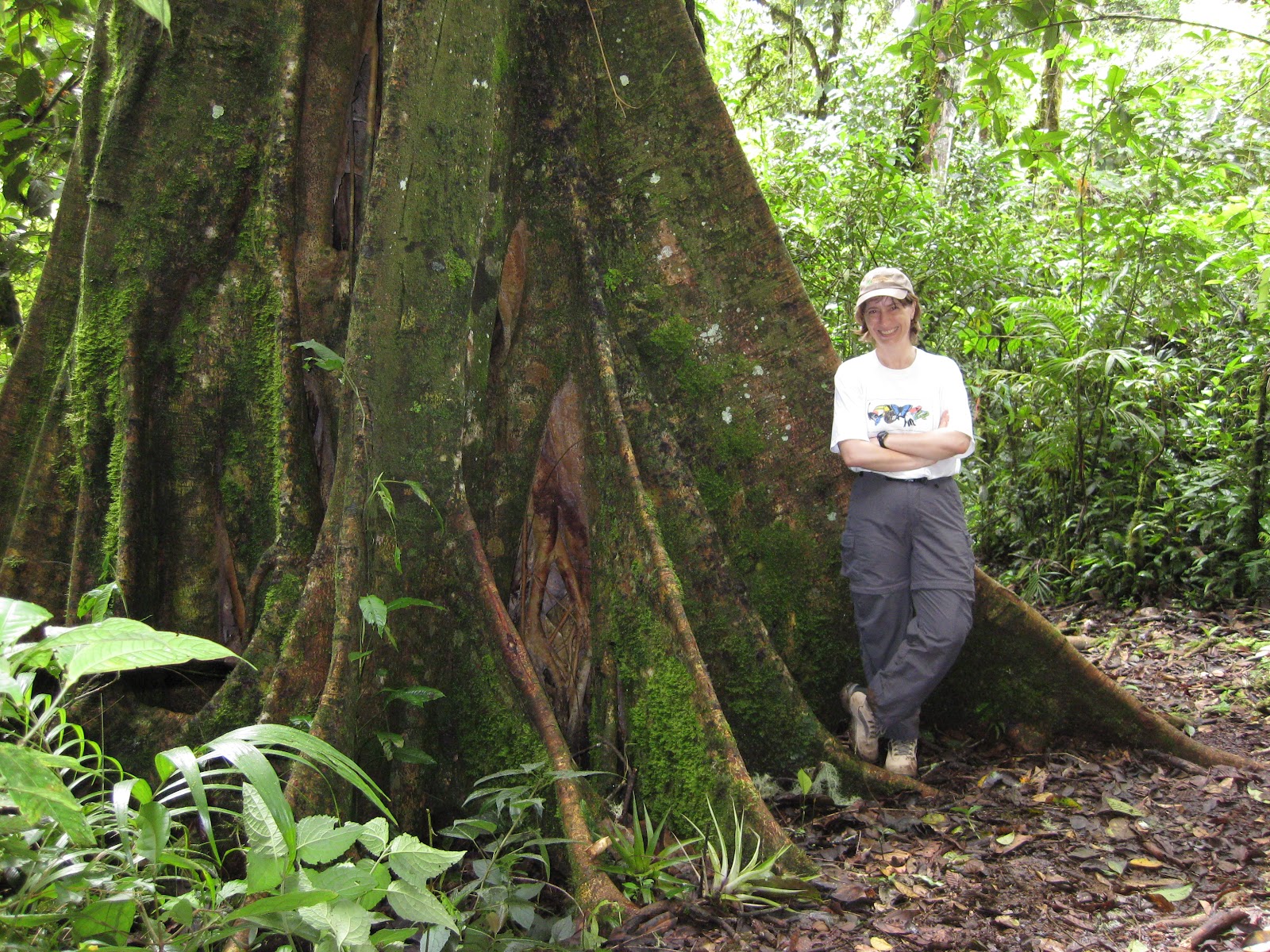
Me in Las Cruces, a few years back.
Some things never change, and my love
for those trees is one of them.
The days are going by fast in this short respite between when spring semester ends and my field season in Costa Rica begins.  This summer I will be participating once again in the Native American and Pacific Islander Research Experience (NAPIRE) Program.  As a research mentor, I'll be supervising the work of three students at Las Cruces Biological Station, a small piece of paradise located in southern Costa Rica, near the border with Panama.

It's been only two years since I participated in NAPIRE, yet it seems like so much longer.  The last time I went to Las Cruces, I had just begun this blog, and signed my first contract with Hadley Rille Books.  Since then, Eolyn has been published, and that one seemingly small event has changed so much in my life, internally and externally, in the way I organize my time and my priorities, in what I want for the future, and how I see myself.  I don't know if any of this will impact my experience at Las Cruces, but it's certainly a moment that has allowed me to see my life is still changing, and I along with it.

I'm invariably inspired to write fun stuff whenever I'm in the woods, so please return to this blog in the coming weeks, so I can share my adventure in the tropics with you.  

In other news, this Saturday I will be at the 6th Annual Author Extravaganza in Emporia, KS.  This event is hosted by the Town Crier Bookstore, and is a celebration of Kansas authors of all genres, and from all walks of life.  If you are in the area, please stop by to visit and meet the authors.  Books will be available for purchase and signing.

This week, I joined the Magic Appreciation Tour and Book Sale.  This is an on-line event, so you can enjoy it wherever you are.  Stop by to meet authors of magical fantasy and find some great summer reading to boot.  The Tour and Book Sale will last until June 30.

I'm getting very excited about WorldCon in Chicago at the end of August.  A couple days ago, I received the list of panels, and they all look great.  I've thrown my hat in the ring to participate in more than a few; as soon as my panels and schedule are confirmed, I'll be sure to post it on this site.

Terri-Lynne DeFino is up this week over at Heroines of Fantasy, and she wants to know what you are doing for yourself.  Stop by to tell her about your plans.  (And if you don't have any plans for yourself, then now is the time to make them!)

I've put together a fun post for next week on Heroines of Fantasy, about some of the non-fantasy books that have most inspired my work, and especially my work with Eolyn.  That post will go live on Monday, June 18.  I hope you will take a moment to visit me there and tell me a little about the books that have most inspired you.

I thought this was going to be a short post, but I guess I did have a lot to talk about!  Next time you see me here, I'll be writing from Costa Rica.  Pura Vida!