"Vigorously told deceptions and battle scenes." ~Publishers Weekly review of Eolyn

"The characters are at their best when the events engulfing them are at their worst." ~Publishers Weekly review of High Maga
Showing posts with label ecology. Show all posts

Friday, August 2, 2013

Savegre Lodge and Ballena Marine National Park


The resplendent quetzal, king of the highland forests
of Talamanca, is set to make a cameo appearance in
Eolyn's third companion novel, Daughter of Aithne.
This week Avila University professor Amy Milakovic and I did a scouting trip for a new course we plan to offer next spring, entitled Ecology through the Writer’s Lens.  The course was inspired during my residency for the Long Term Ecological Reflections (LTER) program at Andrews Experimental Forest in the mountains of Oregon (see my May 2011 posts). 
Like the LTER project, our goal is to integrate scientific and literary approaches to understanding the forest. Of course, we will be working on a much shorter time scale than LTER.  The program at Andrews Experimental Forest is set to run about 300 years; our course will run about 10 days.  Still, it’s going to be a fun and memorable experience for us as professors and for all our students.

On the scouting trip, we visited Savegre Lodge, nestled in the oak forests of the Talamanca Mountains, at about 2300m elevation.  Fans and followers of Eolyn know by now that these are the magnificent forests that inspired Eolyn’s childhood home in the South Woods.
Ballena Marine National Park, Costa Rica
After a night in Talamanca, we visited La Cusinga Lodge in the Pacific lowlands, surrounded by tropical rainforest and overlooking the stunning Ballena Marine National Park.  Along the way, we saw quetzals, monkeys, whales, and all kinds of other wildlife.   We travelled with long-time friend and colleague, Jose Rogelio Vargas, owner of Ruta Verde Tours.
While I was off the grid, Mark Nelson wrote a wonderful reflection for Heroines of Fantasy, marking our 100th post for the blog.  Mark contemplates the same question we will be asking in our upcoming course:  How do the landscapes we encounter inspire the stories we write? Please stop by to read Mark’s post and share your thoughts on this topic.


A howler monkey in the lowland rain forest
Next week, I’ll be starting a blog tour with Orangeberry Book Tours.  The tour will last through September, including guest posts, interviews, reviews, giveaways, Twitter views and Twitter blasts.  Eolyn will also be one of the featured titles for the Orangeberry Book Expo, which runs through the end of August. For the full schedule, visit my author page at OrangeberryBook Tours. I will, of course, post events as they occur here, as well as on my Facebook page and Twitter account for Eolyn.
That’s the news for now.  Enjoy the sunny weeks to come. Autumn is on its way.

Members of this week's tropical expedition (from left to right):
Dr. Amy Milakovic, Rafael Aguilar, me, Jose Rogelio Vargas

Saturday, July 6, 2013

On Writing and Life

The creek that runs behind our property in
Costa Rica.  This is our personal mountain
refuge, and a place where I hope someday to
have my own version of Ghemena's cottage.
Hello, again.  I've been absent for a few weeks from this blog, and from the internet in general.   What can I say?  Life sometimes demands attention in ways that don't involve a computer network. 

The last time I posted, we had recently learned of the death of my father-in-law; the latest in a series of losses that have marked the first months of 2013. 

I was worn out by then, physically and emotionally., and I decided to shut down everything to accompany my husband to Costa Rica, where we participated in the novenario, a 9-day ritual of mourning, with his family. 

On the heels of the novenario, I attended the annual conference of the Association for Tropical Biology and Conservation in San Jose, Costa Rica.  This was the 50th anniversary of ATBC, and so the conference brought together a lot of friends and colleagues, some of whom I had not seen in a very long time.  It was a fun and inspiring conference, yet sobering at the same time.  I realized that in my relatively short (25-year) career as an ecologist, the field has been transformed. 

A quarter of a decade ago, we still had our eyes on exploring and deciphering pristine ecosystems.  Now out of necessity, the bulk of our research has turned to rescuing what we have lost, managing what remains, and understanding what we have created.  Ecologists are tackling a host of new questions: restoration of degraded environments, patterns of diversity in urban areas, and so-called "novel ecosystems" -- never-before-seen assemblages created by a combination of native and introduced species.  It's not that there is nothing pristine left to explore, it's just that there's so much more now outside of those pristine areas that demands to be understood and fixed. 

I'm certain I'll come back to this topic, because it hit me in a deep way and continues to simmer in the back of my thoughts. 

As soon as the conference came to an end, I was on a plane back to Kansas City to enjoy a short but wonderful visit from my brother and his family.  They live in Hong Kong, so it is always a special joy to see them, especially my nieces, now 6 and 2 years old.  We've been blessed with particularly lovely summer weather, sunny and cool all this week, so we've been out and about exploring parks and playgrounds almost every day. 

Now July has begun, and I see half my summer has already flown by. 

What have I done with my time? I ask myself, and I feel like I have done very little.

A new helper joined me in the garden this
summer. I think I will call him "Mr. Guende".
Even though I've been to Costa Rica and back.  Even though I've had invaluable experiences with my family, friends, and colleagues.  Even though my garden is looking better than it has in years.

That's because for an author, what one has done is not measured in people and places, but in words and revisions.  This is at once the strength and weakness of being a writer -- the drive to tell stories keeps us writing, but the drive to write can sometimes keep us from living. 

Maintaining a balance between writing and living is such a fundamental challenge.  Like many authors, the pull toward writing tends to be stronger in me than the pull toward experiencing life.  So when life demands my attention, I often have to order myself to STOP writing, editing, marketing, and so forth.  To let it all go for a few days, a week, a month or more if need be, because in the end, some things are simply more important than getting out that next scene. 

Of course, there are many professional writers who cannot approach their craft in this way.  They must maintain their routine of writing at all costs, because if they stay away even for a day, it's that much harder to 'get back into it'.  I guess I'm lucky not to have that issue.

After the world settles down, after the heavy emotions of death and loss recede, after my beautiful nieces give their good-bye hugs and board the plane to China, I can go home to my computer confident that I will be able to continue the story from where I left off. 

Indeed, the sadness, tears, joy, and laughter that life has given me add dimension and texture to my words.  True, I may have to adjust my personal deadlines, and it may take a little longer than anticipated to finish the work in progress, but I truly believe the story I tell will be better, not worse, for the time I've spent away from the computer. 

So this weekend, after a long break, I will be getting back to narrating the gripping events of Eolyn's third and final novel, Daughter of Aithne. 

If instinct serves me well, next week I'll have a report for you on the cover art for the second novel, High Maga, still on track for a spring 2014 release.

After that?  Only time will tell. . .

Together with my nieces, parents, sister, and brother (and Duke!)
for the 4th of July.  This was the first time in at least a decade
that I've been in the United States for Independence Day.

Wednesday, May 18, 2011

Old Growth Forest

In my first fantasy fiction publication, the short story ‘Turning Point’ ( Zahir, Issue 17), two women struggle to understand the highland forests of Costa Rica, one from a scientific perspective, the other as an artist in the making. Their passionate focus on distinct modes of inquiry generates tension – each comes to resent the other, and neither is capable of seeing the forest through her companion’s eyes. The story ends in separation; one woman abandons her present life to disappear inside a fairy ring; the other remains faithful to her career as a scientist, yet loses herself in the endless task of cataloguing the forest’s smallest creatures.


While this denouement may seem kind of depressing, in truth both women are satisfied with their choices; both will come to know the forest in a way few others have had the privilege to experience. The real tragedy, I suppose, is that no one else will ever learn of the wonderful secrets they discover.

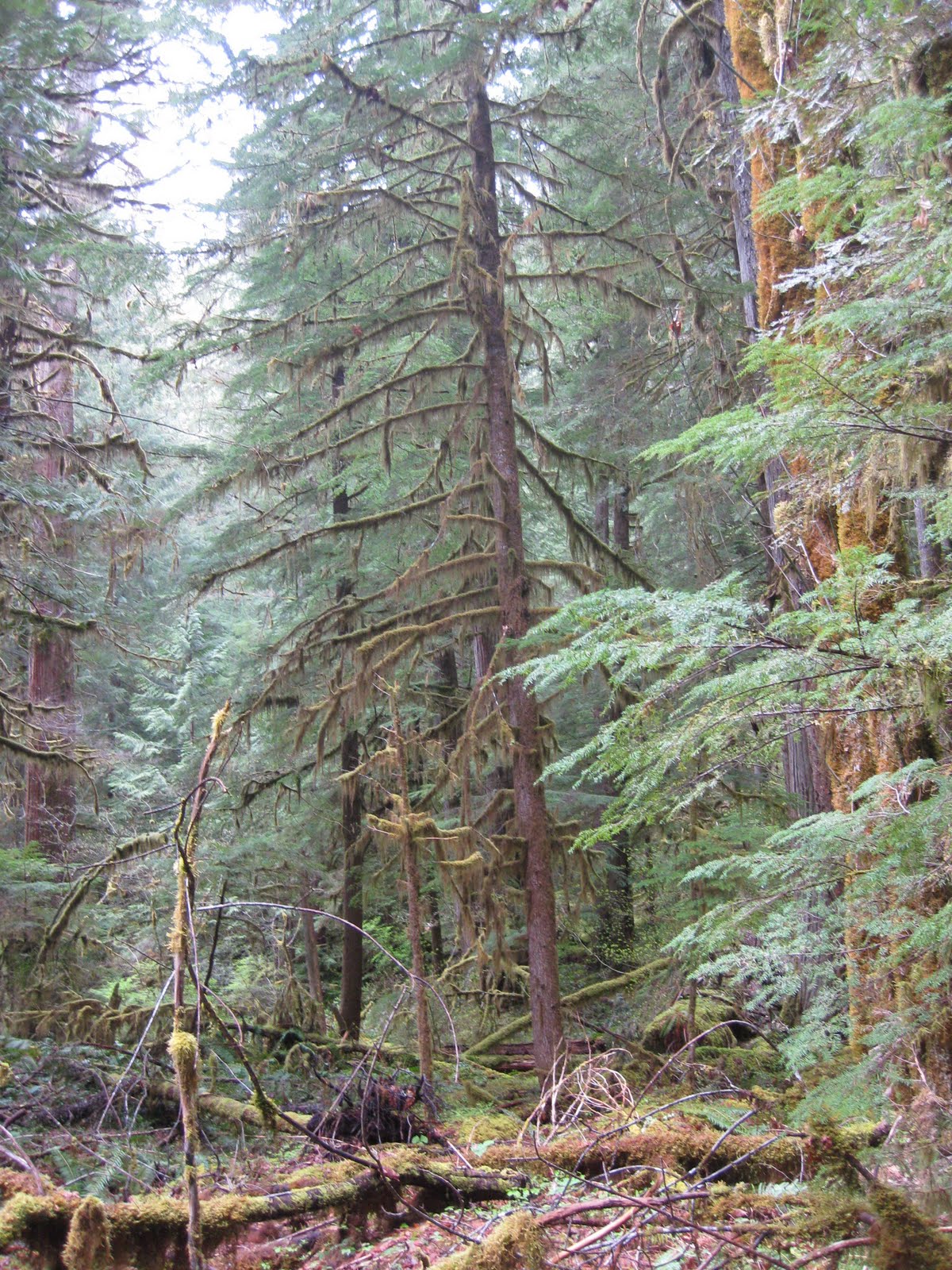
As we hiked through the primary forest of the Cascade Range, I was reminded of this story, and I realized that whether I enter the forest as a biologist or as an author, the challenge remains the same: How can I hope to capture this world and communicate its magnificence and complexity to others?

This is the first time I’ve been asked – formally – to study the forest from a writer's perspective, and I’ve found that my approach in the first moments of the encounter is the same:

I stop.

And then I ‘listen’. With all my senses.

From the sequel to EOLYN (currently in progress):  She pressed her hands against the rough bark, closed her eyes and heard the pulse of the tree, solid and slow, a steady current that stretched toward the sky and descended into the deepest places of the earth, a quiet murmur of indomitable strength.


It is not an easy task to listen, and it is especially difficult to listen to creatures who speak in ways completely foreign to our experience. In the world of Eolyn, Mages and Magas must learn to understand the plants, animals and rocks before they can hope to master any other form of magic. Nor do I – as the author -- make their task made simple by introducing animals that speak English; rather, the maga must come to understand each animal (or plant, or mineral) on its own terms, through its own language and behavioral patterns. This is, in essence, the same task of any modern-day biologist. What we are really trying to do, with all those instruments, data points and statistics, is translate the language of ecosystems into something that can be communicated in meaningful ways to other members of our own species.

Jewels of the forest:  rain water caught by a Trilium plant.
When I ‘listen’ to the forest, the first things I tend to ‘hear’ are the familiar – a plant that belongs to a family I recognize, for example. The way the moss hangs from the branches or covers the logs. The chill of the air. The shape of the fungi. The quiet – which, as I should point out, is not the same as silence. In a forest, sound is ever-present, yet understated. The flow of the river, the hushed sway of the canopy in response to a breeze. The rhythmic chirp of a small bird, like the intermittent squeak of a tiny gate, interrupted by the sudden chatter of another. The distant monotone trill of the varied thrush. The scratch of my pen on paper, the plasticky crunkle of my rain coat.

Now there’s a phrase: ‘plasticky crunkle’. Neither word can be found in the dictionary, but then again, much of what I would like to describe about the experience of old growth forest cannot be found in a dictionary. Imagine if we had a word for every mood, texture, sound, sensation that one experiences in the old growth forests of the Pacific Northwest. What a rich language ours would be.

Walking the trails through Andrews Forest sometimes leaves me at a loss for words – a terrible feeling for a writer – and my immediate response is an intense desire to create new words, new ways of saying things, so that I might capture and communicate the experience.  I will, for example, study the bark of the Douglas-fir for several minutes at a time trying to decide how best to describe it.  This inner tension between a loss for words and the need for words left me wondering today to what extent wilderness has given us our language.

How many times in our long history, has someone walked into a new territory and been compelled to invent novel words or phrases because nothing he or she had handy was sufficient to describe the plants, the animals, the personality of that particular place which had been woven by nature in all its complexity?

And if we destroy old growth forest, leaving behind only the barren earth, or monotonous stands of young plantations, do we not also obliterate the potential for new ways of communication that verdant maze might have inspired?

I don’t have answers to these questions at the moment, but I believe they are worth thinking about. 


This is the second installment of a week-long series of reflections on my writer's residency at Andrews Experimental Forest in Oregon.

Many thanks to Rafael Aguilar Chaves for the photos.