Some exciting news that extends beyond our HIGH MAGA countdown.
As some of you may know, our interdisciplinary studies course, Ecology through the Writer's Lens, did not make enrollment this spring. I suspect the competition was a little two stiff (we had three other equally fantastic travel courses offered at our tiny university) and the price a little too steep.
So, Dr. Amy Milakovic and I have reimagined the course and will be offering it again for fall semester. This time, our focal ecosystem will be PRAIRIE. As part of the course, we will visit the Konza Prairie in western Kansas, a long-term ecological research site and a world-class conservation center. I have been reading Prairie: A Natural History by Candace Savage, and I am getting very exciting for this new adventure! Prairie is a magnificent ecosystem in so many ways, but little understood and invariably under appreciated.
Here's the new video we've put together about the course:
In recent weeks, I've also, after much deliberation, decided to accept a position as co-coordinator for the Native American and Pacific Islander Research Experience (NAPIRE) Program. I have been involved with this program, in one capacity or another, since 2006, and have talked about it often on the blog.
I was a little nervous about accepting the co-coordinator position, as it involves a lot more responsibility -- certainly a different level of responsibility -- compared to being a research mentor, which has been my focus of activities for about eight years now. I suspect I will not be doing much writing in Las Cruces this summer, but the rewards of assuming this new role will almost certainly compensate for that. I met the new coordinator, Barbara Dugelby, at the NAPIRE workshop last January. She is deeply committed to the program, wonderfully organized, and very clear in her communication. I think she's going to be a joy to work with.
All this to say: We are going to Costa Rica this summer!! Stay tuned because as those of you who follow me know, this means weekly posts about fantastic adventures in one of the most beautiful places I know.
If you are unfamiliar with NAPIRE, check out this information video produced by the Organization for Tropical Studies:
Last but not least, some of you may have noticed that the word count for Daughter of Aithne has frozen up during the last couple of months. Don't worry! I am still making progress, though it has been harder with the onset of Eric's illness and the launch of High Maga just around the corner. But I have been working hard, whenever I can, on a revision and rewrite of the first 70,000 words. This is why the word count has not changed, though the novel is moving forward. I am very pleased with what I've been able to do, and glad I've taken the time to go back and tie up some loose ends before continuing.
The Goodreads giveaway for Eolyn ended this morning at 12am. The winners will be contacted shortly to arrange sending out their free signed copies. Congratulations to all of you!
I have a second giveaway planned for High Maga this month. As soon as Goodreads approves it, the giveaway will go live. Four signed copies are up for grabs, so make sure to get your name on the list. Good luck!
On Friday, we continue our countdown to release day with an introduction to two more members of Eolyn's coven: the young magas Ghemena and Mariel.
Have a great week!

Showing posts with label long term ecological reflections. Show all posts
Showing posts with label long term ecological reflections. Show all posts
Tuesday, March 4, 2014
Thursday, September 12, 2013
Vagancias
"Vagancias" is the word in Costa Rican Spanish for the little things we do out of sheer self-indulgence.
You know you enjoy your job when the best parts of your work feel like vagancias. Here are two vagancias I indulged in this week:
For me, the biggest act of self-indulgence on the way to publication is cover design.
Friends and followers of Eolyn, we are sooooo very close to having the cover art finished! I wish I could share with you every delightful piece that Thomas Vandenberg has sent my way over the past several days, but we're just going to have to wait a little longer. Because no matter how fantastic the images so far, Tom still wants to do more.
On Heroines of Fantasy this week, Terri-Lynne DeFino posted a wonderful reflection about the face of women in fantasy. Quite coincidentally, just before this post went live, Tom sent me his rendition of Eolyn. The cover for High Maga will allow us to see her face, and folks she is beautiful. Fierce. Strong. Determined. Most of all, real. Everything you want in a heroine and a maga. (And with no need for any bikini armor.)
I'd love to show you a cover preview with Eolyn's face, but my mother always told me to leave the dessert for last. So here's another appetizer:

In case you're wondering, that's the clawed forelimb of a Naether Demon, creatures summoned from the Underworld to assist the Syrnte army in their invasion of Moisehén.
I confess, all my attempts at secrecy may soon come to naught, as High Maga might get some special and unanticipated exposure in the coming weeks. If that happens, you'll be sure to hear about it. If not, stay tuned for more previews, and several weeks down the road, a full and proper cover reveal.
My second vagancia was for my day job at Avila University. As some of you may remember, we are planning a travel course next spring that will integrate literary and scientific modes of understanding the forest. We have everything set to go; now we just need the students. Yesterday, I sat down with Windows Movie Maker and put together this simple video as a way of spreading the word about the course. It gets me excited about going back to Costa Rica; I hope it gets my students excited, too!
Those were my vagancias this week. What were yours?
You know you enjoy your job when the best parts of your work feel like vagancias. Here are two vagancias I indulged in this week:
Cover Design for HIGH MAGA
For me, the biggest act of self-indulgence on the way to publication is cover design.
Friends and followers of Eolyn, we are sooooo very close to having the cover art finished! I wish I could share with you every delightful piece that Thomas Vandenberg has sent my way over the past several days, but we're just going to have to wait a little longer. Because no matter how fantastic the images so far, Tom still wants to do more.
On Heroines of Fantasy this week, Terri-Lynne DeFino posted a wonderful reflection about the face of women in fantasy. Quite coincidentally, just before this post went live, Tom sent me his rendition of Eolyn. The cover for High Maga will allow us to see her face, and folks she is beautiful. Fierce. Strong. Determined. Most of all, real. Everything you want in a heroine and a maga. (And with no need for any bikini armor.)
I'd love to show you a cover preview with Eolyn's face, but my mother always told me to leave the dessert for last. So here's another appetizer:

In case you're wondering, that's the clawed forelimb of a Naether Demon, creatures summoned from the Underworld to assist the Syrnte army in their invasion of Moisehén.
I confess, all my attempts at secrecy may soon come to naught, as High Maga might get some special and unanticipated exposure in the coming weeks. If that happens, you'll be sure to hear about it. If not, stay tuned for more previews, and several weeks down the road, a full and proper cover reveal.
Promo Video for Ecology Through the Writer's Lens
My second vagancia was for my day job at Avila University. As some of you may remember, we are planning a travel course next spring that will integrate literary and scientific modes of understanding the forest. We have everything set to go; now we just need the students. Yesterday, I sat down with Windows Movie Maker and put together this simple video as a way of spreading the word about the course. It gets me excited about going back to Costa Rica; I hope it gets my students excited, too!
Those were my vagancias this week. What were yours?


Friday, August 2, 2013
Savegre Lodge and Ballena Marine National Park
 |
| The resplendent quetzal, king of the highland forests of Talamanca, is set to make a cameo appearance in Eolyn's third companion novel, Daughter of Aithne. |
This week Avila University professor Amy Milakovic and I did
a scouting trip for a new course we plan to offer next spring, entitled Ecology through the Writer’s Lens. The course was inspired during my
residency for the Long Term Ecological Reflections (LTER) program at
Andrews Experimental Forest in the mountains of Oregon (see my May 2011 posts).
Like the LTER project, our goal is to integrate scientific
and literary approaches to understanding the forest. Of course, we will be
working on a much shorter time scale than LTER.
The program at Andrews Experimental Forest is set to run about 300
years; our course will run about 10 days.
Still, it’s going to be a fun and memorable experience for us as
professors and for all our students.
On the scouting trip, we visited Savegre Lodge, nestled in
the oak forests of the Talamanca Mountains, at about 2300m elevation. Fans and followers of Eolyn know by now that these are the magnificent forests that inspired Eolyn’s
childhood home in the South Woods.
 |
| Ballena Marine National Park, Costa Rica |
After a night in Talamanca, we visited La
Cusinga Lodge in the Pacific lowlands, surrounded by tropical rainforest and
overlooking the stunning Ballena Marine National Park. Along the way, we saw quetzals, monkeys, whales,
and all kinds of other wildlife. We travelled with long-time friend and colleague, Jose Rogelio Vargas, owner of Ruta Verde Tours.
While I was off the grid, Mark Nelson wrote a wonderful
reflection for Heroines of Fantasy, marking
our 100th post for the blog. Mark contemplates the same question we will be asking in our upcoming course: How do the landscapes we encounter inspire the stories we write? Please
stop by to read Mark’s post and share your thoughts on this topic.
 |
| A howler monkey in the lowland rain forest |
Next week, I’ll be starting a blog tour with Orangeberry
Book Tours. The tour will last through
September, including guest posts, interviews, reviews, giveaways, Twitter views
and Twitter blasts. Eolyn will also be
one of the featured titles for the Orangeberry Book Expo, which runs through
the end of August. For the full schedule, visit my author page at OrangeberryBook Tours. I will, of course, post events as they occur here, as well as on my
Facebook page and Twitter account for Eolyn.
That’s the news for now.
Enjoy the sunny weeks to come. Autumn is on its way.  |
| Members of this week's tropical expedition (from left to right): Dr. Amy Milakovic, Rafael Aguilar, me, Jose Rogelio Vargas |
Friday, June 24, 2011
The Landscape of My Imagination

It was wonderful surprise – while I was refreshing my memory of Shelley, Frankenstein, and Romanticism – to come across this same image on Wikipedia. It didn’t take much; just one click on “Romantic” from Wikipedia’s Frankenstein page. The artwork, entitled Wanderer Above the Sea of Fog, is by Casper David Friedrich, a painter of the Romantic period.
I also remember our classroom discussion of Frankenstein, where our teacher talked about the importance of wilderness for the Romantic movement. Shelley is a prime example of this. In her timeless novel, she devotes ample attention to the untamed landscape in which her characters live. Were she alive and writing today, I suspect Shelley would find herself embroiled in some vigorous debates with fellow authors, who now live in a world where generous attention to landscape is often seen as an impediment to a story rather than an integral part of it.
My own writing is heavy on description and landscape. I believe a reader cannot fully understand the characters of a story unless he or she also experiences the setting in which they live -- this because the landscape with which we interact shapes who we are. I would have been a happy camper (literally and figuratively) had I written during the Romantic period. As it is, I am constantly challenged by my readers and fellow authors to strike a balance between my own convictions regarding the importance of landscape and more contemporary lines of thought, which often insist setting is not only unimportant, but actually in the way of the 'real story'.
Why shun landscape in our stories?
This question has come back to me often during these last few years, as I’ve engaged with different perspectives regarding what makes good writing. It has resurfaced again these past few weeks, as I reflect on my experience as writer-in-residence at Andrews Experimental Forest and the short story inspired by it – a story that in its current draft is, perhaps even by my own standards, ‘too heavy’ on description.
But what is ‘too heavy’? What determines the point where we stop looking out the window, because we just don’t want to see anymore? Why is that cutoff in a different place now than it was some 200 years ago, when Shelley wrote her immortal tale?
The biologist and philosopher inside me can’t help but wonder whether rejection of landscape is simply about ‘good technique’ in writing. Perhaps it's more than that. Perhaps it is also a reflection of the context in which so many of us now live: a world where wilderness has been fragmented and pushed to distant corners of the earth; where we have no point of reference for the organic nature of our surroundings, living as we do in climate controlled spaces, attached to our ipods and cell phones, purchasing pre-packaged boneless meats, avoiding fresh fruits and vegetables because they must be peeled, treating our next door neighbors as somehow less ‘real’ than the person we just met on Facebook.
Not that the modern lifestyle is bad perse; just that we lose something, I think, if we let ourselves become too absorbed by it. There’s a larger world out there; larger even than the internet. Filled with sensory experience -- sights, sounds, smells, tastes, textures. A world that would speak to us, if we let it; just as the forests of Moisehén speak to the Magas and Mages of Eolyn's world.
On the opposite end of the spectrum from Romantics like Shelley, I have read contemporary fiction that takes place entirely inside the mind of the main character. While I appreciate the artistry behind this approach to storytelling, it has little appeal to me as a reader. A disembodied mind in an organic world seems not so much a reflection of real life as a precursor to madness. I cannot engage with someone who is so removed from their surroundings; indeed from their own flesh and blood.
I suppose for me as a writer, the landscape and its components – forests, plains, valleys, rivers, cultivated fields, mountains, plants, animals, rocks, weather patterns, and so forth – will always be characters in their own right, and deserve to be treated as such. My protagonists interact in intimate ways with the environment in which they live; so, then, should my readers.
And even though I tend to cull descriptive passages as I move toward the final draft, I'm rarely fully convinced that by doing so I'm creating a better story. Indeed, it often seems like I'm deforesting the landscape of my imagination, just as we have deforested the landscapes of our planet.
This post is part of a series of reflections inspired by my week as a Writer-in-Residence at Andrews Experimental Forest. To learn more about my week at Andrews, visit the links in the box entitled "Spring 2011 Residency at Andrews Forest" on the right hand bar.
Sunday, June 19, 2011
Animating the Forest
 |
| An "Ent" as depicted in the Lord of the Rings film series. |
During a follow up conversation with Frederick J. Swanson, one of the coordinators of the Long Term Ecological Reflections project at Andrews, he expressed interest in knowing more about ‘what I had to let go of’ when trying to consider the forest from a writer’s perspective, having been trained for so long to approach the forest as a scientist.
I’d say the most difficult impulse for me to follow – to put my faith in, so to speak -- was the desire to anthropomorphize the creatures around me, to animate them with human qualities.
It is very common for story tellers (and humans in general) to anthropomorphize animals and other non-human creatures. Walt Disney’s The Lion King, for example, imposes a human social structure and human behavior on lions and their cohorts in the grasslands of Africa, so that what appears to be a story about lions is, in fact, a story about humans dressed up as lions.
Disney, of course, does this with a lot of films; but I chose The Lion King is an example because the first animal social structure I learned about when I began my study of behavioral biology was in fact the lions.
Lions live in matriarchal prides, where territory is shared among sisters and passed from mothers to daughters. Males leave the pride when they reach reproductive age and live alone or in small groups (usually pairs of brothers) until they are able to challenge and replace the reproductive male of another pride. Upon ‘taking over’ a pride, a new male kills all the cubs in that pride, causing the females to enter their reproductive cycle earlier than they would have otherwise. The new male then has about two or three years to sire as many cubs as he can (and see them safely to maturity) before he, in turn, is booted out by a younger, healthier rival, who will then proceed to kill all the cubs that his predecessor sired.
Not the stuff of Disney movies, I suppose. But it was through the lions that I first realized most animals interact with each other in ways that are difficult to understand if measured by a human world view. We must use other tools – in this case, evolutionary theory – to make sense of their behavior.
The danger, for a scientist, of anthropomorphizing is that the moment we dress up another species with human qualities, we handicap our capacity to understand them on their own terms. So as a biologist, I have for years coached myself – and all my students – away from the habit of anthropomorphizing. (I might add that this is also the approach that the Magas and Mages of Eolyn’s world take; they do not impose human qualities on the plants and animals with which they interact; nor do I as the author.)
While I was in Andrews, whenever I found myself wanting to give voice and personality to the trees and other creatures, my first instinct was to back away. But this instinct ran contrary to the number one rule of any creative writer, which is not to censor yourself. In order to honor me-the-writer, I occasionally had to let go of me-the-scientist.
Anthropomorphizing may be treacherous ground for an ecologist, but it can be a powerful tool for the story teller. If used well in the attempt to relate something as complex as the experience of walking through a forest, the occasional anthropomorphic creature allows the reader a familiar thread that can help carry him or her through otherwise unknown territory. How many children, for example, came to love lions because of The Lion King? And would they have been so quick in their affection for this imposing predator, if the first thing they had learned about it was the customary massacre of all those sweet and playful cubs every time a new male takes over a pride?
While I appreciate the benefits of anthropomorphizing, something inside me cringes every time I see a movie – or read a story – where animals think, talk and act like humans. In my own work as a writer I try to avoid this, seeking a balance between making the creatures of Eolyn’s world accessible while respecting their fundamental non-human qualities.
 |
| An "Ent" of Andrews Forest |
Despite all these human-like qualities, Ents never lose their essential tree-ness. I think that’s part of what gives Ents their immortality in our imagination, and why every time I enter a forest, I half expect to see one – whether I’m thinking like a scientist or not.
This is part of a series of reflections based on my experiences as a writer-in-residence at Andrews Experimental Forest in Oregon. If you'd like to read more about my week-long stay at Andrews, check out the links under "Spring 2011 Residency at Andrew Forest" on the right-hand bar.
Sunday, May 22, 2011
The World I Want to Live In

It was my idea to hike up to the meadow overlooking the fourth reflection plot, a relatively recent clear cut (‘recent’ being, in my estimation, about 10 years old). The plot is a mess to walk through. Splintered stumps of dead trees litter the area. The tallest saplings are now up to four meters high, densely packed, with a thorny net of dry ferns, broken twigs and sprawling raspberry bushes underfoot, the latter just beginning to show their happy white flowers. It was almost impossible to navigate the area without getting cut, scraped, tripped up or otherwise waylaid as we tried to reach that meadow.
The brambles didn’t bother me, though. What bothered me was how steep the slope became as we approached the summit.

There were simple treats to distract me from the increasingly difficult climb for a while, like a small flat area where the weight of large animals had beaten down the grass into neat oval shapes. A resting place for deer, we concluded, judging from the tracks and the scat.

Also, the flowers were stunning:
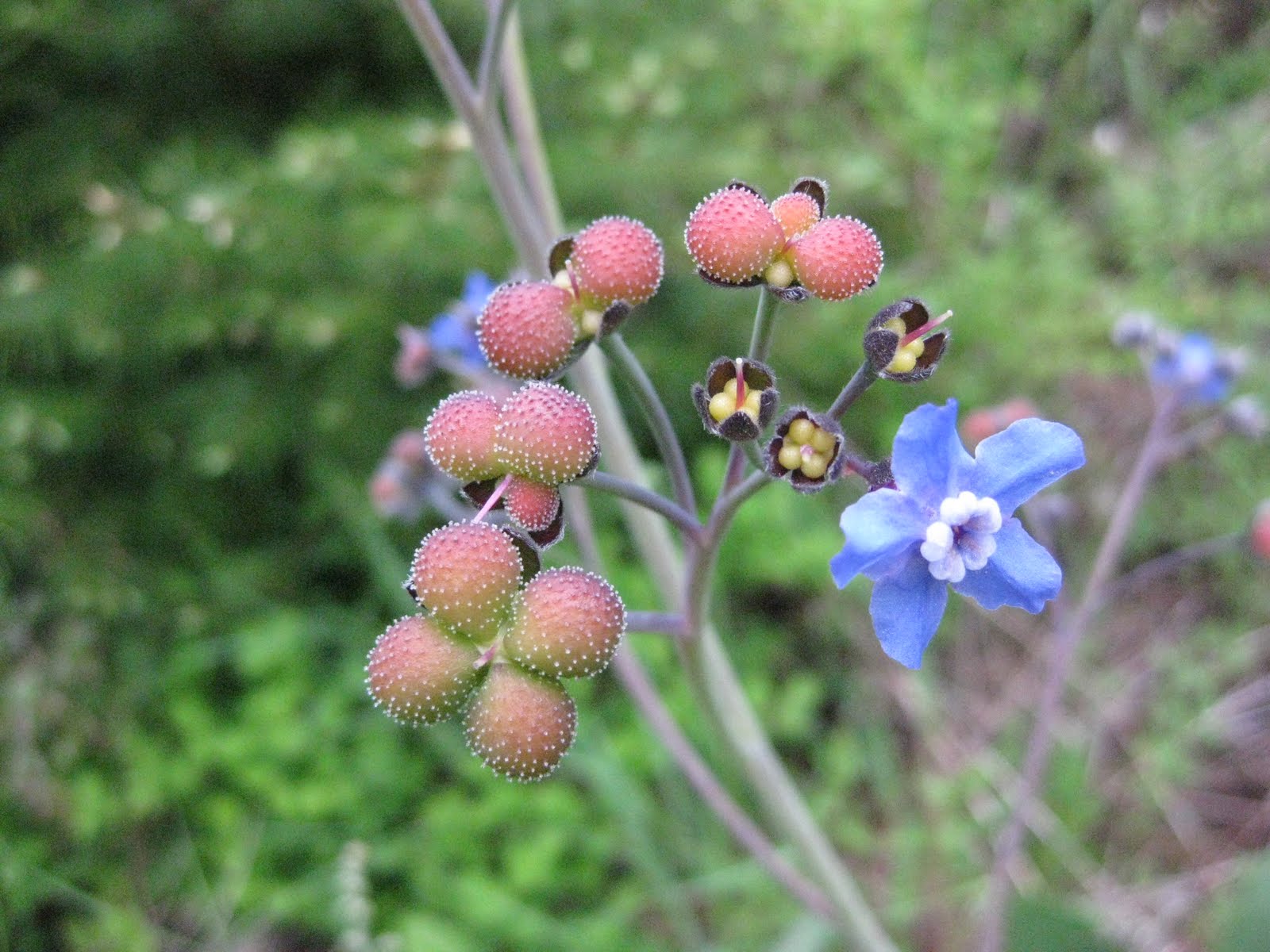
...and there was a beautiful burgundy moss that grew in cushiony patches over the (nearly vertical and rather slippery) charcoal-colored rocks.

With a little help from my intrepid husband, halfway up I found a place where I could squat against the hillside and observe the landscape: a rugged chain of mountains covered in verdant stands of trees interrupted by patches of impossibly steep slopes, where the earth has been robbed of all greenery due to clear cutting.

This was about all I had time to think about before looking down made me dizzy, and I began to fret about how I was ever going to descend that slope, having made it this far up. As for Rafael’s enthusiastic suggestion that we ascend at least a little more – no way was I going to do that. At my insistence, we moved horizontally along the hill to a nearby plantation, and there found another path back down to the road.
Of course, once we returned to the car, I looked up at the meadow and wanted to be there again, and kicked myself for not being able to stay in the first place, or climb even higher, as it would have been a wonderful spot to write a full reflection -- my last reflection as a writer-in-residence at Andrews Forest. But what was done was done. The opportunity to stand upon that particular meadow had come and gone. At least I could say I’d given it a try.
So I sought comfort in a little hot chocolate, and then ventured back a short way into that bramble-carpeted stand of young firs to finish my thoughts on the impacts and aftermath of clearcutting.
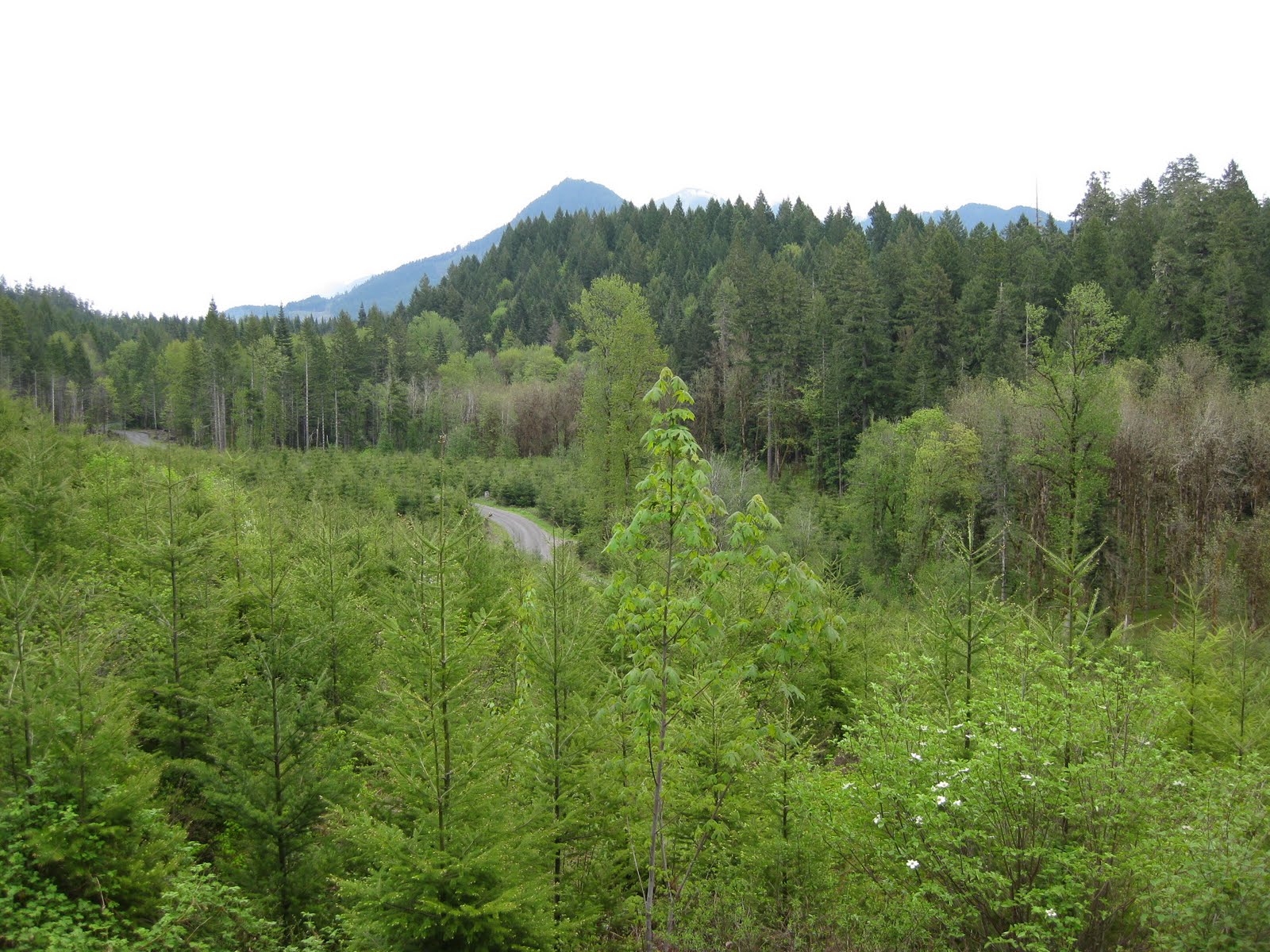


Recent clear cuts are a grim site, but a young patch of forest like this – having rebounded within a few years following mass destruction – is a place of hope. The saplings look young and vigorous, ready for anything, though they do lack the rich character and individuality of their older counterparts. If I could translate the feel of their presence into human-speak, it would go something like this:
Hah! Here we are, ready to go again. You can’t beat us back, little human. All we need is earth, sun, water and time, and we will be old once again, in ways that you can only imagine.
Their determined growth is an act of defiance, really. A mockery of my anthropocentric view of the world. It is as if these young trees somehow know they have a gift I do not. After all, they can endure the passage of time through centuries. Some of them may have four hundred years of life and experience ahead. I have – at this point -- maybe forty.
So who loses out, really, when we raze old growth forest? Granted, there are some notable species we may drive to extinction in our hunger for destruction; the northern spotted owl being a prime example. But the trees, left to their own devices for a few hundred years, given some peace and distance from us bothersome humans, will weave their magic once again. They will rebuild their forest, slowly and inexhorably, filling it with beauty, mystery and complexity. By the time they have finished, we will no longer be around to see their work of art. Indeed, our legacies as individuals -- and perhaps even as a people -- will have been long forgotten.
We often think of conservation as something we engage in for the good of future generations; and in a very deep and important way, it is. Yet there are many aspects of conservation that are not just about the future, and Old Growth Forest is one of them. Once these ancient forests are gone, they will not return. Not in our lifetime, not for our children, nor for our children’s children. Not for many human generations to come.
So the question I have in mind, when I contemplate these treasures of thought and imagination, is not only “What kind of world do I want to leave behind for those to come?” The question I also ask is, “What kind of world do I want to live in right now?”

This is the sixth installment in my weeklong series as a Writer-in-Residence for the Andrews Forest Long Term Ecological Reflections Program.
Many thanks to Rafael Aguilar Chaves for the photos.
Subscribe to:
Posts (Atom)